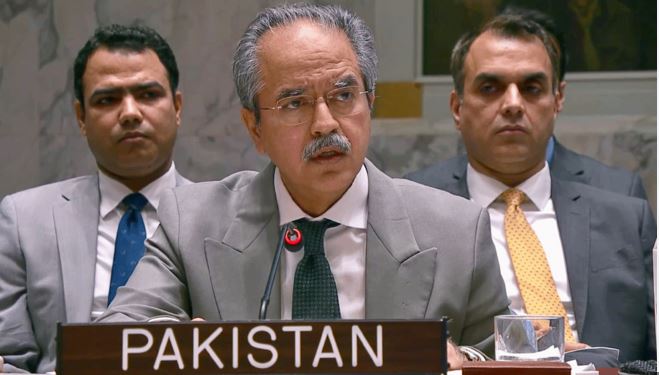
Pakistan stresses ‘shared prosperity’ in global race for critical minerals
Ambassador Asim rejects India’s water terrorism
UNITED NATIONS: Pakistan told the UN Security Council that the world’s natural resources must serve as instruments of economic development and shared prosperity, and not coercion or conflict, as critical minerals now underpin the technologies powering the digital economy and the energy transition.
“The scramble for natural resources and its linkage to conflict and instability is not new,” Ambassador Asim Iftikhar Ahmad, permanent representative of Pakistan to the UN, said in a debate on “Energy, critical minerals and security” under the 15-member Council’s agenda item “Maintenance of international peace and security.”
Advocating a change of course, he said, the upsurge has generated new geopolitical and geo-economic pressures. “If not managed responsibly, competition over natural resources can affect supply chains, aggravate tensions, undermine sovereignty, and contribute to instability.”
In this regard, the Pakistani envoy underscored that shared water resources are indispensable for sustaining life, and for sustainable development and prosperity.
“We reject the weaponization of water to choke this lifeline for lower riparians, also threatening regional peace, security and stability,” Ambassador Asim Ahmad said.
Pakistan, he said, is itself confronted with water terrorism by India that has resorted to unilateral and unlawful action of putting in abeyance the 1960 Indus Waters Treaty in violations of international law and the provisions of that Treaty.
“The international community must impress upon India to return to full compliance with the Indus Waters Treaty, which remains valid and in-force as per the August 2025 award of the Court of Arbitration.”
United States Secretary of Energy Chris Wright chaired the meeting, as US holds the presidency of the Security Council for the month of March.
“Where mineral wealth intersects with weak governance, entrenched poverty and external interference, the risks of instability increase,”Ambassador Asim Ahmad said, referring to several conflict-affected settings, illicit extraction, trafficking networks and opaque financial flows have fuelling armed conflict and violence, weakening state institutions and depriving populations of legitimate revenues.
“The production and trade in critical minerals must respect national ownership, domestic priorities, and the right of developing countries to pursue value addition and industrialization, with a view to transforming them from mere raw material exporters to integrated hubs for processing and refining,” he said.
“Efforts to secure supply must not devolve into bloc-politics, economic coercion or exclusionary arrangements, thereby ensuring that supply chain diversification does not become a tool for geopolitical containment. Fragmentation of global markets will undermine both energy transition objectives and collective security.”
In this era of technological transformation, the Pakistani envoy said the governance of energy and critical minerals must remain firmly anchored in the UN Charter and international law. Managed in accordance with these principles, these resources could drive sustainable development and shared global prosperity.
“Mismanaged or exploited, they risk deepening inequalities and intensifying geopolitical tensions,” he added.
Opening the debate, Rosemary DiCarlo, United Nations Under-Secretary-General for Political and Peacebuilding Affairs, told the Security Council that critical minerals are now “among the main drivers of the twenty-first-century economy”, essential to everything from smartphones to electric vehicles and medical technologies.
In recent years, minerals like lithium, cobalt, and nickel have shifted from limited strategic value to resources that underpin the technologies powering the digital economy and the energy transition. APP