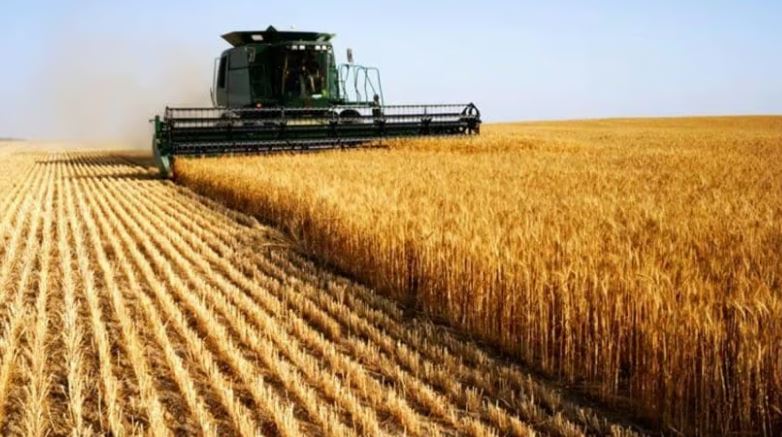
Wheat production estimated at 29.310m tons
ISLAMABAD: The Federal Committee on Agriculture (FCA) was informed on Tuesday that wheat production for the Rabi 2025–26 season is estimated at 29.310 million metric tons, with the crop cultivated over 9.385 million hectares across key wheat-growing regions of the country.
The FCA, which mandated to oversee strategic measures for ensuring food security in the country, was met with Minister for National Food Security and Research, Rana Tanveer Hussain in chair reviewed the performance of Rabi crop and fixed the targets for the Kharif season.
Reviewing the performance of Rabi crops (2025–26), the committee was informed that onion production is estimated at 2,701.78 thousand tons from an area of 163.75 thousand hectares, reflecting a slight decrease in area and production compared to last year. Meanwhile, the tomato production is estimated at 555.72 thousand tons from an area of 41.99 thousand hectares, showing a decrease in production of 11.9% due to a decrease in area of 12.1% compared to last year. Potato production is estimated at 12,171.0 thousand tons from an area of 466.56 thousand hectares, indicating an increase in production of 23.2% over the last year.
Gram production is estimated at 262.03 thousand tons from an area of 782.24 thousand hectares, registering an increase in production of 52.4% over the last year. The Committee noted that the current government has prioritized agriculture to boost the country’s economy and uplift the livelihood of the people. The committee deliberated on production targets for essential Kharif crops (2026–27) and decided to fix a rice production target at 9.17 million tons by cultivating the crop over 3.39 million hectares, whereas the maize output during the season was fixed at 9.77 million tons by sowing the crop over 1.5 million hectares.
The production target for sugarcane was fixed at 80.3 million tons over an area of 1.14 million hectares, while cotton production was fixed at 9.64 million bales over an area of 2.16 million hectares. Targets for other crops such as mung, mash, and chilies were also fixed.
Discussing the availability of agricultural inputs for Kharif crops (2026), the committee was informed that water availability at canal heads will remain 67.451 million acre-feet (MAF) during the Kharif season. The Pakistan Meteorological Department informed that above-average precipitation during March till the first decadal of April has improved the situation to some extent over most parts of the country; however, due to drier conditions in previous months, soil moisture, especially in major agricultural plains, remains under stress.
The committee was informed that the availability of rice and maize seed will remain sufficient as per requirement. The Chief, National Fertilizer Development Center, informed that due to local production and available stocks, the supply position of urea will remain comfortable.
The representative of the State Bank of Pakistan informed that the expected allocation of institutional credit for agriculture has increased to Rs. 3,062 billion in FY-26, which is 19 percent higher than last year’s disbursement of Rs. 2,577 billion.
Addressing the meeting, the Federal Minister stated that achieving food security requires a clear focus on improving domestic agricultural productivity, particularly by increasing per-acre yields. While noting that food availability in Pakistan is generally adequate, he observed that affordability remains a key challenge, especially for low-income groups.
He highlighted that the Interim National Wheat Policy 2025–26, approved by the Federal Cabinet on November 19, 2025, is being implemented across the country to support the farmer community and encourage private sector investment in the wheat sector value chain. He reiterated that the Federal Government will support farmers with all possible means in the prevailing economic conditions.
The minister observed that Pakistan has strong potential in crops, livestock, and fisheries, but long-term growth depends on how efficiently these resources are utilized. He emphasized the need for adopting modern farming technologies, climate-smart practices, and developing efficient marketing systems to connect farmers with domestic and international markets, while also underscoring the importance of open and trade facilitation policies. APP