Maryam, Nawaz Sharif meet Tashkent Governor, agree to strengthen economic cooperation
Uzbekistan urges expansion of trade, investment ties with Pakistan at LCCI Business Forum
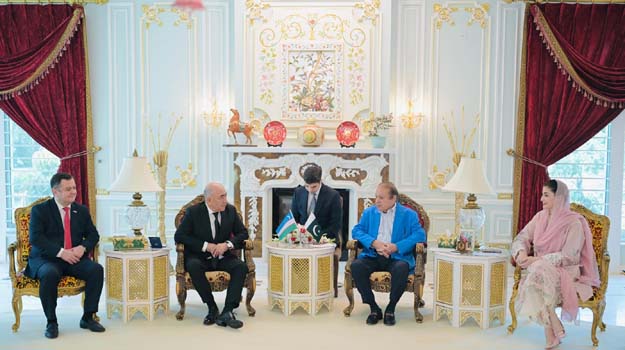
LAHORE: Punjab Chief Minister Maryam Nawaz Sharif and PML-N President Muhammad Nawaz Sharif held a meeting with Governor of Tashkent Region Zoir Mirzaev and his seven-member delegation, here on Wednesday.
Both sides agreed to strengthen bilateral economic and cultural ties, declaring Punjab and Tashkent as sister provinces and forming a special committee to promote cooperation in key sectors such as tourism, agriculture, livestock, meat processing, beverages, and citrus production. The delegation also discussed a proposal to establish a Babur Park in Lahore.
Governor Mirzaev lauded the Punjab government’s efforts in restoring Mughal-era heritage sites and conveyed a message of goodwill from the President of Uzbekistan for the people of Pakistan, particularly in Punjab.
Chief Minister Maryam Nawaz expressed her gratitude and accepted an invitation to visit Uzbekistan. She described Uzbekistan as a brotherly nation and emphasised Punjab’s economic potential, saying that the province produces about 70 per cent of Pakistan’s agricultural output and hosts key industrial hubs including Sialkot, Wazirabad, and Faisalabad.
The CM highlighted the quality of Pakistani rice, maize, and wheat, and stressed ongoing efforts to improve value-added agricultural and livestock products, particularly meat, for export. She expressed confidence that bilateral cooperation could yield significant results, citing Pakistan’s growing leadership in value-added textiles with strong global demand.
On the occasion, PML-N President Nawaz Sharif said the people of Pakistan take pride in Uzbekistan’s rich cultural and scholarly heritage, noting that Samarkand has historically been a centre of knowledge and learning. He remarked that the first Mughal emperor came to the subcontinent from Fergana Valley and that his remarkable rule continues to be remembered in history. He also highlighted Lahore’s centuries-old heritage and expressed his deep affection for the city, recalling that he would often visit Lahore even during his tenure as prime minister.
Governor Mirzaev termed the meeting an honour and underscored opportunities for collaboration in tourism, pharmaceuticals, agriculture, and textiles, particularly polyester, encouraging Pakistani companies to explore joint ventures.
Uzbekistan urges expansion of trade, investment ties with Pakistan at LCCI Business Forum
Tashkent Region Governor Mirzaev Zoir Toirovich on Wednesday stressed the need to significantly expand economic cooperation between Uzbekistan and Pakistan, noting that the current bilateral trade volume of $445.8 million does not reflect the true potential of the two friendly countries.
He called for stronger partnerships in agriculture, textiles, pharmaceuticals, tourism, logistics and industrial investment.
He said Uzbekistan’s economy has maintained steady growth of around six percent annually, while foreign investment continues to increase. Special economic zones across the country, he added, are offering attractive incentives and secure opportunities for international investors, including Pakistani businesses seeking expansion into Central Asia.
Governor Mirzaev was addressing a business forum at the Lahore Chamber of Commerce and Industry (LCCI) during the visit of a 20-member high-level Uzbek delegation led by him. The delegation was accompanied by Uzbekistan’s Ambassador to Pakistan, Alisher Tukhtaev Khakimovich.
LCCI President Faheem-ur-Rehman Saigol welcomed the delegation and termed the visit an important step toward strengthening institutional and business linkages between Pakistan and Uzbekistan. LCCI Senior Vice President Tanveer Ahmed Sheikh, Vice President Khurram Lodhi, SAARC Chamber of Commerce and Industry Vice President Mian Anjum Nisar and members of the executive committee were also present.
The visiting delegation included Governor of Akhangaran District Bahromjon Turaevich, Governor of Kuyichirchik District Akmal Arslanovich, Head of the Territorial Department of the Chamber of Commerce and Industry of Uzbekistan in Tashkent Region Abdurasul Abdurashidovich, Deputy Head of Investments, Industry and Trade Umid Ubaydullaev, Advisor to the Governor for Development of Local Industry Dilshod Azadovich Rasulov, Assistant to the Governor Hurshid Nuritdin, and representatives of leading Uzbek enterprises from multiple industrial sectors.
In his welcome address, Faheem-ur-Rehman Saigol said Uzbekistan has emerged as one of Central Asia’s most promising economies, with imports exceeding $35 billion, presenting vast opportunities for Pakistani exporters and investors. He noted that the sectors represented by the Uzbek delegation — including livestock, dairy production, rice cultivation, textiles, leather, wool processing, construction materials, sports goods and medical equipment — closely align with Pakistan’s industrial and agricultural strengths, creating natural grounds for collaboration.
He highlighted Pakistan’s export potential, stating that rice exports in 2024-25 reached about $3.3 billion, while textile exports, the backbone of Pakistan’s economy, stood at around $18 billion. He added that Pakistan’s livestock sector contributes nearly 15 percent to GDP, with milk production exceeding 72 million tonnes, offering strong prospects for cooperation in dairy processing, livestock development and agricultural technologies.
Saigol said that despite deep historical and cultural ties, bilateral trade remains below potential and requires structured engagement through joint ventures, technology transfer and value-added industrial cooperation. He proposed collaboration in agro-processing, textile value chains and industrial partnerships to enhance productivity and competitiveness in both economies.
He also highlighted opportunities for educational cooperation through student exchange programmes, noting that Pakistani universities offer high-quality and affordable education in medicine, engineering, business and information technology. Saigol further informed the delegation that an Uzbekistan Visa Facilitation Center is fully operational at the LCCI to assist Pakistani businessmen interested in exploring opportunities in Uzbekistan.
Addressing the forum, Governor Mirzaev said Uzbekistan has undergone significant economic transformation over the past decade through transparency policies and market reforms. He noted that more than 80,000 factories operate in the Tashkent region alone, including around 2,500 foreign-invested enterprises, while 22 joint ventures already exist with Pakistani partners.
He identified agriculture and livestock as priority areas, noting Uzbekistan’s growing demand for meat imports and expressing interest in cooperation with Pakistan in livestock production and processing. He said Uzbekistan produces nearly four million tonnes of cotton annually and invited collaboration with Pakistani industries in textile manufacturing and artificial fiber production to strengthen value chains.
The governor also highlighted strong opportunities in pharmaceuticals, stating that Uzbekistan currently produces only about 30 percent of its domestic pharmaceutical requirements and imports the remaining 70 percent, creating significant opportunities for Pakistani pharmaceutical exporters and investors.
He further pointed to tourism cooperation, revealing that nearly 98,000 hectares of land in the Tashkent region have been allocated for tourism development, with several countries already investing in hotels and resorts.
Governor Mirzaev assured Pakistani investors of full government support, investment protection and attractive incentives within Uzbekistan’s special economic zones, emphasizing that the main objective of the visit was to establish direct business linkages and long-term industrial cooperation between the two countries.
Speaking on the occasion, Uzbekistan’s Ambassador to Pakistan, Alisher Tukhtaev Khakimovich, said relations between Uzbekistan and Pakistan are entering a new phase, driven by strong political trust and expanding economic engagement. He emphasized that the business communities of both countries must play a central role in transforming diplomatic goodwill into tangible outcomes such as investments, employment opportunities and industrial projects.
The ambassador described Uzbekistan as a strategic gateway to the Central Asian market of more than 80 million people, while Pakistan offers access to a consumer market of over 250 million, along with critical maritime connectivity through the ports of Karachi Port, Port Qasim and Gwadar Port. He highlighted ongoing economic reforms in Uzbekistan aimed at improving the ease of doing business, expanding industrial zones and strengthening private-sector growth.
He also underscored improving connectivity between the two countries, noting that direct flights between Uzbekistan and Pakistan have increased significantly, with additional flights planned between Tashkent and Lahore, while new routes to Karachi are also under consideration. He added that the proposed Trans-Afghan Railway could transform regional trade by linking Central Asia directly with Pakistani seaports.
The ambassador further noted that Uzbekistan has simplified visa procedures for Pakistani citizens and invited businessmen to establish joint ventures in various sectors. He said the country’s rapid economic growth, rising foreign investment inflows and competitive energy and infrastructure costs offer strong incentives for Pakistani investors.
The event concluded with detailed presentations on the economic potential of the Tashkent Region, followed by B2B meetings between Pakistani and Uzbek companies to explore trade partnerships, investment prospects and long-term economic collaboration, marking another step forward in strengthening Pakistan–Uzbekistan economic relations.