Failure to enforce NAP fuelling resurgence in terrorism: DG ISPR
Urges KP govt to protect its people, not beg to Afghanistan for security
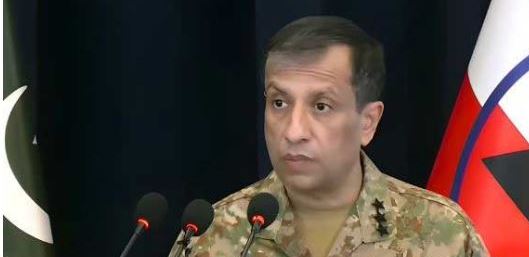
PESHAWAR: Failure to enforce the National Action Plan (NAP) agreed upon by all political parties is causing a surge in terrorism, said ISPR Director General Lt Gen Ahmed Sharif Chaudhry.
Addressing a press conference on the security situation in Khyber-Pakhtunkhwa on Friday, he said that the K-P has been on the frontlines of Pakistan’s counterterrorism campaign for the past two decades. When the frequency of terrorist incidents increased again in 2021, security forces gave a “firm and effective” responsive, he said. More Khwarij have been killed in the recent past than in the last nine years combined, added Lt Gen Chaudhry.
He began the press conference, streaming live on You Tube, paying tribute to the “brave and resilient people” of K-P, acknowledging their sacrifices alongside the armed forces in the fight against terrorism.
DG ISPR blamed weak governance and the neglect of NAP for the surge in terrorism, particularly in Khyber-Pakhtunkhwa (K-P), where “around 70 per cent of the country’s terrorist acts take place.” He noted Pakistan, and K-P in particular, has faced terrorism for the past two decades. He revisited the revised 2021 NAP points, highlighting intolerance for militancy, action against terrorism in media and cyberspace, curbing terror financing, follow-up of Counter Terrorism (CT) cases in courts, capacity building for CTDs, regulation of seminaries, and reforms in the criminal justice system.
During the press conference, the DG ISPR was also asked about media reports alleging a strike was carried out in Kabul last night to eliminate the banned terror outfit Tehreek-i-Taliban Pakistan’s (TTP) leader Noor Wali Mehsud.
In his response, he said the army had taken note of the reports circulating on social media and the statement issued by the Taliban spokesperson.
Without naming any party, he attributed the worsening security situation in K-P to internal lapses. “The provincial government has fallen into the terror-crime nexus,” he said, referring to illegal activities such as narcotics trade and non-custom-paid vehicles that “allowed lawlessness to flourish and terrorism to breed.”
“When the suggestion was made to seal the Pak-Afghan border, there were people in power who opposed it—only to keep their criminal activities going,” he added. “Terrorism exists today because we are not following the NAP.” DG ISPR said terrorism’s roots lay not just across the border but within Pakistan’s governance failures. “Why is 70 per cent of all terrorist activity in K-P and Balochistan, and not in the other two provinces? The answer is good governance,” he said. He accused the K-P government of politicising counterterrorism and weakening the state’s resolve by seeking negotiations with militants. “Calling for talks with non-state actors is a failure of governance,” he remarked. He shared operational data during the confernece that in 2024, 14,535 intelligence-based operations (IBOs) in K-P killed 769 terrorists—including 58 Afghan nationals—while 272 army and FC personnel, 140 policemen, and 165 civilians were martyred.
In 2025, until September 15, 10,115 operations killed 970 terrorists and martyred 311 army personnel. Nationwide, 57,320 IBOs were conducted in 2025, with 2,809 of 3,984 terrorist incidents (70.5%) occurring in K-P, and 917 of 1,422 terrorists killed nationwide eliminated in K-P. “The main battleground remains Khyber-Pakhtunkhwa and Balochistan,” he said. “We still conduct trade with Afghanistan. We share historical, cultural, and religious ties. But we cannot allow them to house people who harm Pakistan. All alphas of non-state actors are there,” he said. Staff Report