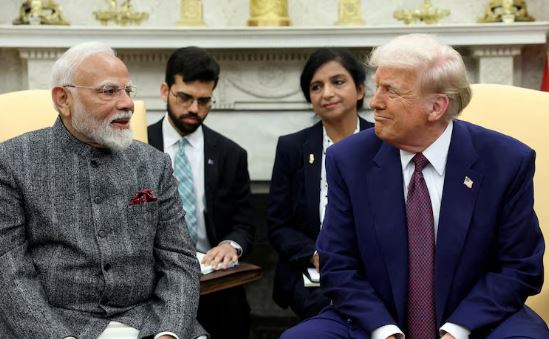
Trump says India offered to reduce tariffs on US goods to zero
Saudi Aramco, Iraq’s SOMO halt crude sales to Indian refiner Nayara, sources say
Web Desk
WASHINGTON: US President Donald Trump said on Monday that India has offered to reduce its tariffs on US goods to zero, even as Indian Prime Minister Narendra Modi was making public shows of solidarity with Chinese and Russian leaders in the face of trade pressure from Washington.
While calling the US relationship with India “one sided,” Trump wrote on his Truth Social platform: “They have now offered to cut their Tariffs to nothing, but it’s getting late. They should have done so years ago.”
The Indian Embassy in Washington did not immediately respond to Trump’s comments, which follow the implementation of total duties as high as 50% on Indian goods that have raised questions about the future of the US-India relationship.
Trump’s remark came as Modi was in China for a summit of more than 20 leaders of non-Western countries of the Shanghai Cooperation Organisation, a China-backed initiative given renewed impetus by Trump’s global tariff offensive.
At the summit, Chinese President Xi Jinping pressed his vision for a new global security and economic order that prioritises the “Global South,” in a direct challenge to the US. The US-India relationship has strengthened in recent years, including during Trump’s first term, given shared concerns about China’s growing power, but Trump threatened the tariffs on India after it refused to stop buying Russian oil in defiance of his efforts to end Moscow’s war in Ukraine.
In China, in an image designed to convey solidarity, Putin and Modi were shown holding hands as they walked jovially toward Xi before the summit opened. The three men stood shoulder-to-shoulder, laughing and surrounded by interpreters.
Beijing has used the summit to mend ties with New Delhi. Modi, visiting China for the first time in seven years, and Xi agreed on Sunday their countries are development partners, not rivals, and discussed ways to improve trade.
The US State Department and White House did not immediately respond to requests for comment on the meetings in China.
Saudi Aramco, Iraq’s SOMO halt crude sales to Indian refiner Nayara, sources say
Saudi Aramco and Iraq’s state oil company SOMO have stopped selling crude oil to India’s Nayara Energy in the aftermath of sanctions imposed in July by the European Union on the Russian-backed refiner, three sources familiar with the matter said.
The halting of supply from the two Gulf exporters means Nayara, majority-owned by Russian entities including oil major Rosneft, relied entirely on Russia for its crude oil imports in August, according to sources and LSEG shipping data.
Nayara typically receives around 2 million barrels of Iraqi crude and 1 million barrels of Saudi crude each month, but did not receive shipments from either of the two suppliers during August, shipping data from Kpler and LSEG showed.
SOMO and Nayara did not respond to requests for comment. Saudi Aramco declined to comment.
Two of the sources said that the sanctions had created payment problems for Nayara’s purchases from SOMO, without providing further details.
The most recent cargo of Basra crude from SOMO was discharged for Nayara by the Kalliopi, a very large crude carrier (VLCC), at Vadinar port on July 29, according to Kpler and LSEG data as well as data obtained from industry sources.
The private refiner received 1 million barrels of Arab Light carried by the VLCC Georgios co-loaded with a similar quantity of Basrah heavy on July 18, its last Saudi delivery, according to LSEG data.
Nayara is receiving direct supplies from Rosneft, an official from the Russian Embassy in New Delhi said last month.
The private company is operating its 400,000 barrel-per-day refinery at Vadinar in western India at about 70-80% capacity due to difficulties in selling its products resulting from the sanctions, sources have said.
Nayara Energy, which controls about 8% of India’s 5.2 million barrel-per-day refining capacity, has been struggling to transport fuel since the EU sanctions, relying on so-called dark fleet vessels after other shippers backed out, according to shipping reports and LSEG data.
The company’s CEO resigned in July. Last week, Nayara announced the appointment of a senior executive from Azerbaijan’s national oil company SOCAR as its chief executive.