Pope demands ‘collective punishment’ end in Gaza as 10 more die of hunger
Israeli strikes killat least 76 people across the Strip in last 24 hours
Monitoring Desk
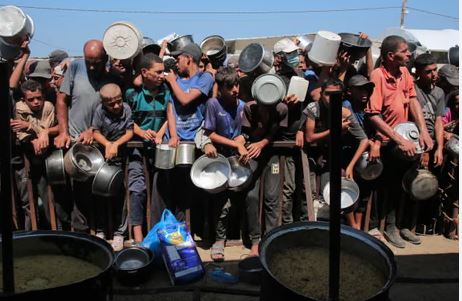
GAZA: Ten Palestinians, including two children, have died from starvation in the last 24 hours, the health authorities in Gaza said on Wednesday, as Pope Leo XIV demanded that Israel stop its “collective punishment” of the population in the besieged territory.
At least 313 people have died from hunger, including 119 children, since the war in Gaza began and Israel intensified its siege on the Palestinian territory. Last week a UN-backed monitoring body confirmed that Gaza was in the throes of famine, warning that without more aid increasing numbers of people would lose access to food.
As humanitarian conditions continued to worsen, the pope called for a suspension of hostilities.
“I beg for a permanent ceasefire to be reached, the safe entry of humanitarian aid to be facilitated and humanitarian law to be fully respected,” Leo said. He referred to international law and its “prohibition of collective punishment, indiscriminate use of force and the forced displacement of the population”.
The pope was interrupted twice by applause as he called for a ceasefire in front of thousands of people in the Vatican auditorium.
Despite calls for a ceasefire, Israeli tanks rolled into the outskirts of Gaza City overnight, destroying houses and displacing residents. Tanks shelled the Ebad al-Rahmanneighbourhood on the northern outskirts of the city, causing injuries, as Israeli forces sought to clear a path into Gaza City before its expected offensive.
Israeli strikes and fire killed at least 76 people throughout Gaza in the previous 24 hours, the Gaza health authorities said.
Palestinians, many of whom have already been displaced, are being forced to flee Gaza City before Israel’s expected offensive in the area
The Israeli military said that it was operating in Jabaliya and on the outskirts of Gaza City to “dismantle terror infrastructure sites and eliminate terrorists”. It claimed to have killed a senior Hamas member, Mahmoud al-Aswad, who was the militia’s head of intelligence for west Gaza.
Israel has said that it will launch its new offensive in Gaza City regardless of whether a ceasefire is reached, describing the city as Hamas’s last stronghold in the strip.
The city has become densely populated during the war as Palestinians fled from other areas. Gaza City now holds about 1 million people – half the population of the strip – who Israel said will be ordered to leave.
Humanitarians have warned that such mass forcible displacement is not only against international law, but would exacerbate already dismal humanitarian conditions in Gaza.
Israel has brushed off such concerns, with an Israeli military spokesperson, AvichayAdraee, saying on Wednesday that “evacuating Gaza City is inevitable”. Israel has already asked humanitarians in the north and south of Gaza to prepare for an influx of people and said that increased number of tents had been sent to the territory.
“Before transitioning to the next phase in the war, I wish to confirm that there are vast empty areas in the southern strip, just as is the case in the central camps and in al-Mawasi. These areas are free of tents,” said Adraee, sharing a map of separate, discrete “empty zones” in southern Gaza.
Thousands of Gaza City’s residents have already left, fleeing intensifying Israeli bombardment. However, local church leaders said that they would not leave and that people sheltering in the churches were too weak and malnourished to move and displacement would be “a death sentence”.
“For this reason, the clergy and nuns have decided to remain and continue to care for all those who will be in the compounds,” said the Greek Orthodox Patriarchate and the Latin Patriarchate of Jerusalem in a joint statement.
The Israeli military has regularly published evacuation orders over the last 22 months in Gaza, and much of the population has been displaced several times. More than 80% of Gaza is designated as an Israeli military zone or subject to displacement orders, the UN said in June.
Continued displacement has exacerbated health and sanitary conditions, leading to the spread of disease.