Indian media fumes as all eyes on Pakistan for world peace
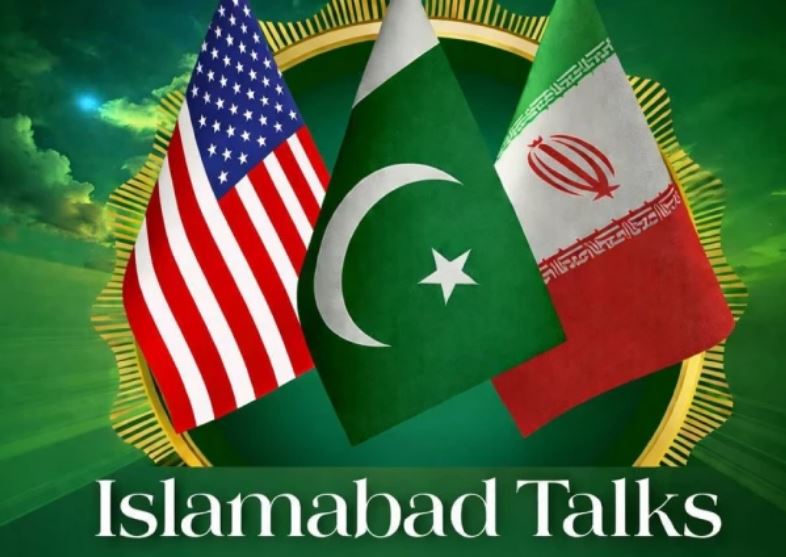
ISLAMABAD: As the ‘Islamabad Talks’ between the United States and Iran began on Saturday, the world watched closely except for some “evil eyes” across the border still clinging to propaganda over nuance.
Former United States diplomat Jeffery Gunter did not hold back when an Indian anchor pressed him on whether US Vice President JD Vance would be safe in Pakistan.
Giving them what can only be described as a televised reality check, Gunter said, “I feel like the schoolteacher about to discipline each and every one of you.”
He did not stop there.
“This is about lives. This is about livelihood. This is about expensive gasoline for everyday Indians, everyday Americans,” he said during a live broadcast on Times Now, before calling out the drama unfolding in front of him.
Turning a serious geopolitical moment into a Pakistan versus India shouting match, he added, was “actually quite embarrassing” and “shameful”.
You could almost hear the collective detention bell ring.
Because right now, all eyes are on Pakistan. Some are watching with curiosity, others with cautious hope that maybe, just maybe, peace might actually stand a chance. And yet, there are some “evil eyes” in the room too, two of them very visibly, Israel and India.
Both appear unsettled by the direction things are taking. Israel launched strikes in Lebanon almost immediately after Prime Minister Shehbaz Sharif spoke of a ceasefire, while across the border, Indian media slipped into overdrive, spinning narratives before facts had time to land.
Prime-time debates on leading Indian news channels, including Aaj Tak, Republic TV, and Times Now, have expressed surprise and concern over Pakistan’s emerging role as a diplomatic bridge between the Middle East and the West, noting that it challenges the long-held perception of Pakistan’s international isolation.
But this ceasefire is beyond this. If the conflict spirals, the fallout will not politely stay confined to one region. It will travel to South Asia, to Europe, and well beyond, bringing energy shocks, rising inflation, disrupted trade, and humanitarian crises, the kind of domino effect no one really signs up for. In moments like this, urgency is expected, not theatre.
Yet instead of restraint, what we saw was performance, where urgency was the need of the hour, but parts of the Indian media chose spectacle instead.
Take one rather cinematic episode. A live broadcast of India Today confidently claimed, citing “Israeli sources”, that Vance would not even make it to Pakistan. According to this version of events, his plane might turn around mid-air and head back to the US.
Across social media, particularly in Indian and Israeli spaces, the reaction has ranged from dismissive to outright mocking.
“Indian media chagrin on Pakistan hosting the talks was a sad spectacle. Their wanting it to fail is even more so. Grow up, India,” said Javed Hassan, a Pakistani economist and public policy expert, commenting on the reaction of sections of the Indian media to the developments in Islamabad.
Even a Swedish-Indian political scientist and professor at Uppsala University, Ashok Swain, called the Indian media a “joke”.
Some media outlets went rogue while others have been less subtle, recycling familiar talking points with the kind of enthusiasm usually reserved for breaking news. Staff Report