FM Fidan: Israel is the biggest obstacle to Peace
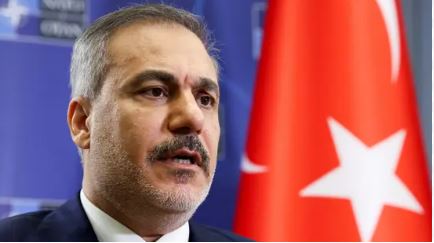
ANKARA: Israel remains the single greatest barrier to peace in the Middle East, Turkey’s Foreign Minister Hakan Fidan said, warning that continued warfare threatens to deepen regional instability and entrench long-term divisions between societies.
“At this point, the biggest obstacle to peace is Israel’s position,” Mr. Fidan said during a live broadcast on a Haber.
He explained that Israel continues to leverage its structural influence over U.S. politics while pursuing a broader strategic agenda for the region.
“If Israel believes there are further opportunities to exploit or deepen the conflict based on its analysis of the current war, it will continue on this path,” he stated.
Mr. Fidan said Turkey’s priority from the outset has been to prevent the conflict, contain its spread, and keep the country out of the war.
He added that Turkey continues to push for an immediate cease-fire and a diplomatic resolution.
‘Both the American public and the international community are asking’
Mr. Fidan noted that the United States is facing mounting domestic pressure ahead of upcoming elections, with public scrutiny over the war intensifying.
He said Washington’s initial military objectives—first targeting Iran’s nuclear capabilities and later its missile and defense infrastructure—have largely been declared achieved.
“Both the American public and the international community are asking: if these objectives have been met, why continue a war that carries serious global economic consequences?” he said.
The minister pointed to increasing pressure on the U.S. administration to justify prolonging the conflict, adding that this has fueled ongoing, albeit cautious, efforts toward a diplomatic resolution.
‘The world cannot apply meaningful pressure on Israel’
Mr. Fidan stressed that a key challenge remains the international community’s inability to exert effective pressure on Israel, similar to the situation seen in Gaza.
“The problem, as in Gaza and other cases, is that the world cannot apply meaningful pressure on Israel,” he said.
He added that if the United States seeks a negotiated settlement with Iran, it must be willing to use its influence over Israel more decisively.
“If Washington is to reach an agreement with Iran, it must be willing to exercise serious leverage over Israel,” Mr. Fidan said. “We will see who can exert influence over whom.”
He described the situation as a structural issue at the heart of the conflict.
‘Even if this war ends, the instability could last for years’
Mr. Fidan warned that beyond immediate destruction, the conflict risks leaving behind long-term instability, comparing its impact to lasting damage that can prevent recovery for decades.
“Even if this war ends at some point, the instability it leaves behind could last for years,” he said. “Conflicts between societies and countries can create deep-rooted hostility, making cooperation, development and prosperity nearly impossible.”
He said Turkey has been working intensively through diplomatic channels since the outbreak of the conflict to push for a cease-fire and de-escalation.
Negotiations appear to have reached an initial stage, he added, with indirect contacts underway through Pakistan and coordination continuing with both the United States and Iran.
“Today, we held extensive talks with both sides to better understand their positions and expectations,” Mr. Fidan said, noting that Turkey is actively conveying messages between the parties.
He emphasized that initial positions in negotiations are often deliberately set high and should not be taken at face value.
“If there is genuine intent on both sides, a point of convergence can always be found,” he said.
The top Turkish diplomat stressed that the key to progress lies in sustaining negotiations, ensuring sincerity, and rebuilding trust between the parties.
‘A dangerous seed of discord has been sown’
Mr. Fidan said Israel’s actions during the war risk planting long-term divisions across the region, warning that the conflict could make unity among Muslim countries increasingly difficult.
“At this stage, we see that as war was launched against Iran, a dangerous seed of discord has also been sown in the region through Israeli expansionism—one that could make it nearly impossible for Muslims in the region to come together again,” he said.
He stressed that Turkey’s top priority is to prevent such divisions from taking root.
Mr. Fidan recalled that during the previous “12-day war,” Iran refrained from targeting Gulf countries despite being attacked, and said Turkey encouraged a similar approach in the current situation.
“We advised all parties: remain patient and avoid reactions that could leave lasting damage,” he said. “This would play directly into Israel’s desired scenario—prolonged conflict among Islamic countries in the region.”
Mr. Fidan said Turkey has consistently urged both Iran and other regional actors not to fall into what he described as a trap.
“This is why we are often targeted by Israel, because we recognize this strategy and are trying to counter it,” he added.
‘The dominant psychology is: we are under attack and must respond’
He acknowledged that the prevailing mood in the region is far from calm, with countries increasingly adopting more hardline positions due to ongoing attacks.
“The dominant psychology is: ‘We are under attack and must respond,’” Mr. Fidan said, noting that even countries that have supported Iran are now leaning toward stronger reactions.
He said Turkey, along with Pakistan, has been among the few actors reminding regional countries to focus on the broader picture and underlying causes of the conflict.
“Many countries are acting under pressure, as they are facing missile strikes and attacks, and are struggling to respond to their own public, which is living under constant alarm and in shelters,” he said.
Mr. Fidan added that Turkey has sought to calm tensions, including during a high-level meeting in Riyadh convened to address the attacks.
He noted that tensions escalated further even during the Riyadh meeting, with missiles launched toward the Saudi capital.
Mr. Fidan also warned that unforeseen developments could still arise, regardless of the parties’ intentions, but said Turkey is maintaining intensive contacts at the highest level to prevent escalation.
He highlighted the role of regional mediators, saying Pakistan is playing a central role, while Turkey is in constant coordination with Egypt and other countries in the region. European partners are also closely engaged in diplomatic efforts.
Mr. Fidan said there is a broad global consensus, similar to the Gaza war, that the conflict must end as soon as possible, stressing that this expectation now needs to be translated into concrete action by key countries. Monitoring Desk