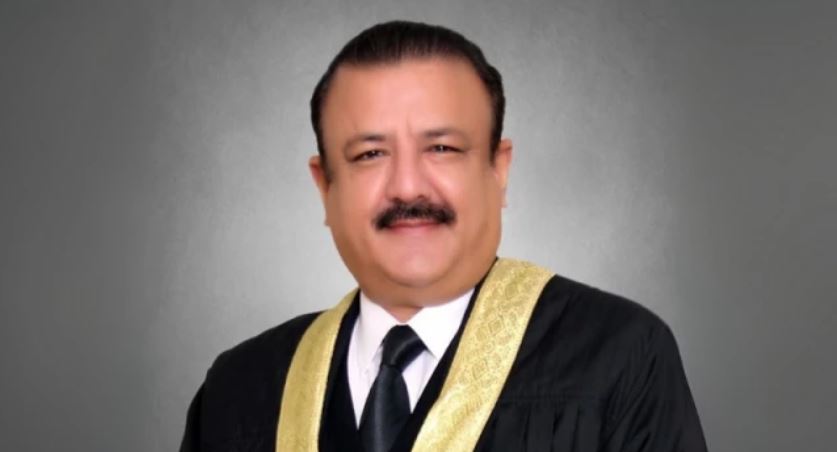
Justice Jahangiri objects to IHC CJ-led division bench hearing fake degree case
ISLAMABAD: Justice Tariq Mehmood Jahangiri appeared before the Islamabad High Court (IHC) on Monday, presenting arguments in his defence against challenges to the legitimacy of his law degree and appointment as a judge while also raising objections over the division bench hearing the case.
The controversy surrounding the IHC judge’s law degree originated from a letter that began circulating last year on social media, purportedly from the University of Karachi’s (KU) controller of examinations.
Subsequently, a complaint pertaining to his allegedly fake degree was submitted to the Supreme Judicial Council — the top forum for judicial accountability that probes allegations of misconduct against judges — last year in July and a petition challenging his appointment was also filed in the IHC earlier this year by lawyer Mian Dawood.
A two-member IHC bench, led by Chief Justice Sardar Muhammad Sarfraz Dogar and also comprising Justice Muhammad Azam Khan, took up the matter on Monday in a packed courtroom.
The same bench had declared Dawood’s plea maintainable at the last hearing on December 9, issuing a verdict that was reserved in July last year. It had also barred Justice Jahangiri from judicial work in September, but the order was later set aside by the Supreme Court (SC).
Arguing his case, Justice Jahangiri raised the preliminary objection that the division bench was “inappropriate” to hear the case as a separate petition concerning its members was pending.
This, apparently, was a reference to challenges to Justice Dogar’s appointment as the IHC CJ.
“We have filed a petition against you. You cannot hear this case,” Justice Jahangiri asserted.
Moving on to defending his qualification, he contended that the case was based on a 34-year-old educational record.
“I am ready to take an oath on the Holy Quran that my degree is genuine,” he contended. The judge also argued that the KU never declared his degree fake.
He also took an exception to the “haste” in which proceedings were being held, arguing against the issuance of a three-day notice to address a decades-old matter. Monitoring Desk