Fazal objects to legislations enacted to combat child marriages, domestic violence
ISLAMABAD: Jamiat Ulema-i-Islam-Fazl (JUI-F) chief Maulana Fazal Rehman on Tuesday strongly objected to recent legislations aimed at reducing domestic violence, protecting children from child marriages, and safeguarding transgender community’s rights.
On November 13, the National Assembly also passed a bill — awaiting the Senate’s approval — to protect people against domestic violence in Islamabad. A day later, the Balochistan Assembly adopted a bill to ban child marriages with a majority, amidst a protest by opposition lawmakers, including JUI-F’s Younis Zehri.
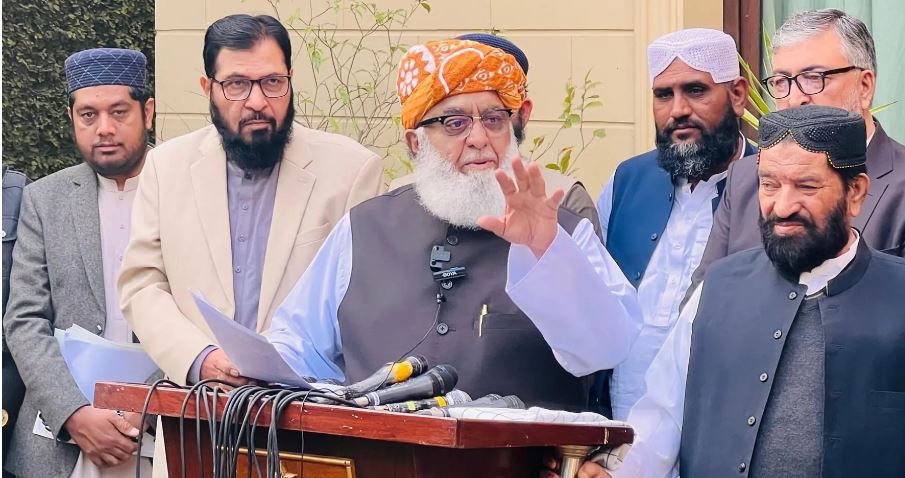
Addressing the media in Islamabad on Tuesday, the JUI-F chief said, “Some legislation has been enacted regarding the marriage of children below the age of 18 years, regarding transgenders, and regarding domestic violence.”
The Domestic Violence (Prevention and Protection) Bill 2025 aims to establish an effective system of protection, relief and rehabilitation of women, men, transgender persons, children and any vulnerable person against domestic violence. It provides jail terms ranging from six months to three years, and a fine of up to Rs100,000, if the offence does not fall under the Pakistan Penal Code.
Speaking about child marriages, Fazal took exception to terming those under 18 as “na-baaligh” (minors), asking which sect’s Islamic laws stated as such.
“Strengthening the law to the point that if a marriage or nikkah is done before 18, it will be called sexual abuse and will be interpreted as rape, and a punishment will be given accordingly,” he said.
Pakistan is home to over 19 million child brides, with nearly 1 in 6 young women married before the age of 18, according to the United Nations International Children’s Emergency Fund (Unicef).
While Sindh and the Islamabad Capital Territory already enforce 18 as the minimum marriage age for girls, the Punjab government is also set to introduce the Child Marriage Restraint Act to set the same threshold.
During his media talk, the JUI-F chief also criticised the Protection of Women Bill 2006, which had been introduced amid opposition from religious parties during Gen Pervez Musharraf’s dictatorship, to amend widely criticised Hudood laws.
He pointedly said the PPP had voted in favour of that bill, and “today as well, hindrances were being created in the way of permitted nikkah”. The PPP is in power in Balochistan, where the recent anti-child marriage bill and the transgender policy were introduced.
Fazal went on to term it a “weird point” and a “joke” that, although child marriages would be considered as rape, a child born out of it would be legitimate. “And the father will be bound to pay for its expenses,” he added.
It is unclear whether any of the recent legislation specified this. However, in March, the Lahore High Court ruled that a biological father was under an obligation to maintain his child even if born as a consequence of rape.
On the legislation pertaining to the transgender community, Fazl sought the “justification” for individuals born as a “complete male or a complete female” being allowed to change their gender.
“Perhaps, they do not even have as much freedom there in the West as we have given them here in the Islamic Republic of Pakistan,” he claimed. Staff Report