US-Iran direct talks underway after PM meets visiting delegations
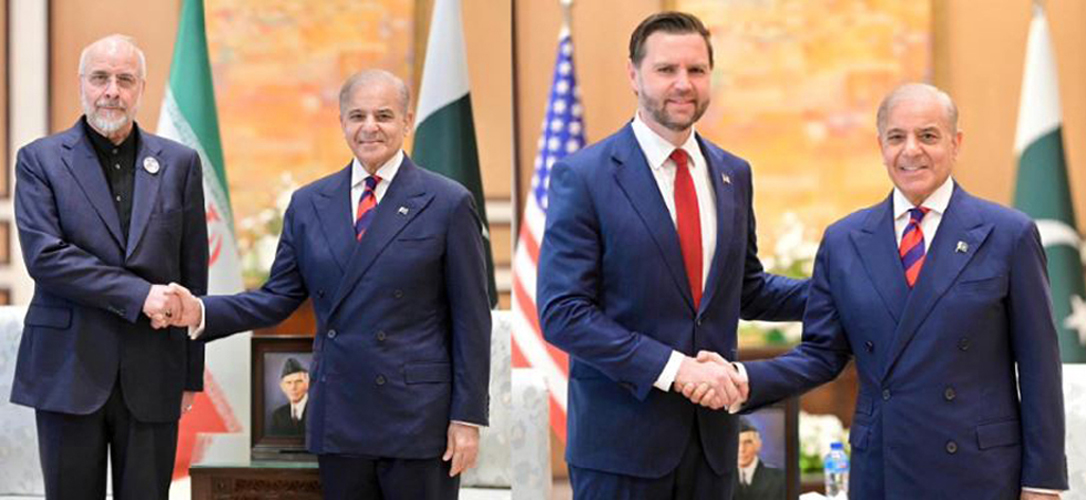
ISLAMABAD: Prime Minister Shehbaz Sharif on Saturday held separate meetings with US and Iranian delegations as the Islamabad talks kicked off, expressing optimism that the negotiations could help advance lasting peace in the Middle East.
US Vice President JD Vance-led delegation was accompanied by Special Envoy Steve Witkoff and President Donald Trump’s son-in-law Jared Kushner, while the prime minister was assisted by Deputy Prime Minister and Foreign Minister Ishaq Dar and Interior Minister Senator Mohsin Raza Naqvi.
Commending the commitment of both delegations to engage constructively, the prime minister expressed hope that the talks would serve as a stepping stone toward durable peace in the region.
He reiterated that Pakistan looks forward to continuing its role in facilitating both sides in making progress towards sustainable peace.
The meeting comes shortly after a high-level US delegation headed by Vice President Vance and comprising Witkoff and Kushner, arrived in Islamabad earlier on Saturday to participate in the negotiations.
The talks followed a two-week ceasefire announced by President Trump after weeks of conflict that saw US and Israeli strikes on Iran.
Despite the pause, tensions remain high, particularly over the Strait of Hormuz and ongoing hostilities involving Israel and Iran-backed Hezbollah in Lebanon.
Late in the day, PM Shehbaz held a meeting with the Iranian delegation. The Iranian side was led by the Speaker of the Iranian Consultative Assembly, Mohammad Bagher Ghalibaf, assisted by Foreign Minister Abbas Araghchi.
Appreciating Iran’s engagement in the Islamabad Talks, PM Shehbaz affirmed Pakistan’s sincere resolve to continue playing its role as a mediator to help build momentum towards achieving meaningful results in the interest of regional and global peace and stability.
DPM Dar, Chief of Army Staff and Chief of Defence Forces Field Marshal Asim Munir and Interior Minister Naqvi attended the meeting from Pakistani side.
Ahead of the talks, Ghalibaf stressed that Washington must fulfil prior commitments, including easing restrictions on Iranian assets and ensuring a ceasefire in Lebanon, warning that progress would otherwise be difficult.
Vice President Vance expressed cautious optimism about the outcome but warned that any attempt by Iran to undermine the process would draw a firm response.
As delegations from the US and Iran sit down for critical negotiations in Islamabad, a wide-ranging but complex issues are expected to dominate the discussion.
Negotiations are structured around two competing proposals: a 10-point framework presented by Iran and a 15-point plan advanced by the United States. While both sides have expressed willingness to engage, significant differences remain.
At the heart of the negotiations is Iran’s nuclear programme. Washington is pressing for firm guarantees that Tehran will not develop nuclear weapons, alongside strict limits on uranium enrichment and intrusive monitoring by the IAEA.
Iran, however, is seeking recognition of its right to pursue peaceful nuclear activities, including enrichment, which it considers a matter of national sovereignty. Staff Report