Pakistan backs Arab League’s stand against foreign occupation
UNITED NATIONS: Pakistan has called for stronger UN-Arab league cooperation in the crisis-ridden Middle East, highlighting that a priority of the 22-member League’s is the resolution of long outstanding disputes such as those arising from foreign occupation.
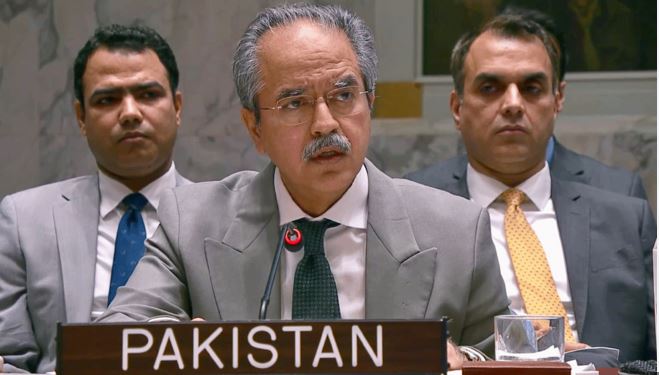
“We hope the ongoing international efforts will lead to a time-bound and irreversible political process, anchored in relevant UN resolutions, culminating in the establishment of a sovereign, independent and contiguous State of Palestine on the basis of pre-1967 borders, with Al-Quds Al-Sharif as its capital,” Ambassador Asim Iftikhar Ahmad, permanent representative of Pakistan to the UN, told the UN Security Council which met on Thursday afternoon to discuss the ned to boost UN’s cooperation with the League of Arab States.
The afternoon session of the 15-member Council complemented a morning meeting held on collaboration between the United Nations and the Gulf Cooperation Council (GCC).This meeting occurs under the umbrella of the Council’s consideration of cooperation between the UN, regional and subregional organizations in maintaining international peace and security.
“A key priority for the League, for the Council and indeed for Pakistan is the resolution of long-outstanding disputes, particularly those arising from foreign occupation and the denial of the right to self-determination,” the Pakistani envoy said.
The League, he said, has played a leading role in addressing the unresolved Palestinian question that remains at the core of the Arab-Israeli conflict.
The Palestinian people continue to be victims of occupation and dispossession, the Pakistani envoy said, demanding that Israel vacate its illegal occupation of all Arab territories, including in Palestine, Syria and Lebanon.
“Arab and OIC [Organization of Islamic Cooperation] representation is so important at this table,” he added.
As the US-Israel war against Iran escalates, Ambassador Asim Ahmad said that the immediate goal must be complete cessation of all hostilities and return to dialogue for peaceful resolution of all issues.
“Our brothers, Gulf members of the Arab League are facing direct attacks on their soil, totally unacceptable, while grappling with challenges posed by restricted navigation in the Strait of Hormuz.”
“Together with other partners, Pakistan is actively engaged in promoting this objective,” he said, noting that UNSC Resolution 2788, adopted last July, reflects the Council’s commitment to preventive diplomacy and peaceful settlement of disputes. “Its implementation remains critical to advancing collective efforts toward peace and stability.”
Ambassador Asim Ahmad said that the League, one of the oldest and most prominent regional organizations, has long advanced peace in the Arab world.
“Strengthening partnerships between the United Nations and the League is not merely desirable, it is indispensable,’ the Pakistani envoy added.
Outlining priorities for the region, Khiari started by underlining the need to consolidate the ceasefire in Gaza and “turn this narrow but important opening into irreversible progress”.
Meanwhile, in Lebanon, he welcomed the League’s consistent call for full implementation of resolution 1701 (2006) amidst rising tensions and mass displacement triggered by Israeli evacuation orders. He also detailed continuing engagement towards recovery and political transition in Syria, overcoming the stalemate in Libya, ending the fighting in Sudan and inclusive dialogue in Somalia.
Khiari said that the UN looks forward to deepening this partnership in the years ahead “for the benefit of the peoples of the Arab region and beyond”. APP