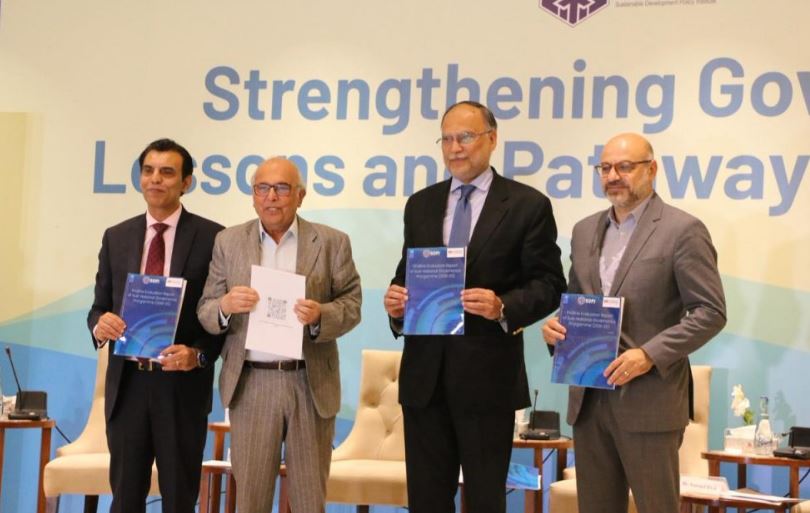
Governance key to Pakistan’s transformation, not just policy debate: Ahsan
ISLAMABAD: Federal Minister for Planning, Development and Special Initiatives Ahsan Iqbal on Friday said that governance is the face of a state that citizens encounter daily at federal, provincial, district and grassroots levels, thus strengthening these tiers of democracy is essential to bring about meaningful reforms.
He was addressing a high-level policy dialogue titled “Strengthening Governance: Lessons and Pathways from SNG-II,” jointly organized by United Nations Development Programme Pakistan (UNDP) and Sustainable Development Policy Institute (SDPI), said a press release.
The minister stressed that governance is the decisive factor between transformation and stagnation in Pakistan, urging stakeholders to translate evidence-based reforms into action to improve service delivery and institutional performance across provinces and districts.
Felicitating SDPI for conducting an important evidence-based evaluation exercise, the minister said Pakistan does not lack plans but suffers from weaknesses in implementation, policies and institutions. “Governance is not a technical discussion for seminars alone; it is the difference between plans that move forward and files that gather dust,” he remarked.
He explained that for ordinary citizens governance is reflected in everyday experiences such as whether teachers reach schools on time, whether Basic Health Units function properly and whether roads are repaired efficiently.
Highlighting Pakistan’s current regional and economic challenges, he said the country stands at a critical point of inflection and stability remains the “runway” required for national take-off. He described governance as the first pillar of the government’s URaan Pakistan framework and emphasized that business-as-usual approaches must be replaced with proactive system-wide reforms.
Referring to the 18th amendment to the Constitution, the minister termed it a historic milestone that strengthened the federation by devolving powers to provinces, but noted that the process remained incomplete due to insufficient empowerment at district and local levels. “Devolution remains unfinished without strong local governments,” he said, stressing that provincial capitals alone cannot effectively address the challenges of remote districts and towns.
He underscored that the next generation of governance reforms must focus equally on provincial and grassroots levels to ensure citizen-centric service delivery. He also called for shifting planning and budgeting priorities from expenditure utilization to measurable outcomes and emphasized the need for transparent public finance management and resource mobilization rather than development cuts.
The minister said reforms cannot be delivered by government alone and require coordinated efforts by think tanks, development partners and civil society. “Pakistan’s challenge is converting potential into performance, and that is only possible through governance,” he concluded, urging stakeholders to translate evidence into actionable reforms.
Speaking earlier, Samuel Rizk, Resident Representative of UNDP Pakistan, appreciated SDPI’s role in evaluating governance reforms and noted that governance is often not prioritized in the shrinking global development space despite its central importance for sustainable development outcomes.
He said the Sub-National Governance Programme (SNG-II) highlighted the need for resilient institutions capable of responding to crises and financial constraints, adding that local resilience is critical for effective governance. He stressed that ownership of governance reforms must now be strengthened after the completion of SNG-II and called for integrating governance priorities into government budgeting frameworks and national development planning.
He also emphasized linking national development projects more closely with governance reforms and appreciated the continued support of the Foreign, Commonwealth & Development Office (FCDO) as well as SDPI’s leadership in conducting the independent evaluation.
Earlier, in his opening remarks, Dr. Abid Qaiyum Suleri, Executive Director SDPI, said the global landscape is undergoing rapid transformation due to geopolitical tensions and shifting regional dynamics, requiring governance systems to remain adaptive and responsive. He linked the consultation with the recent Pakistan Governance Forum under the URAAN programme, noting that the present dialogue complemented macro-level discussions with provincial-level insights. He described successful provincial initiatives as “islands of success” that can contribute significantly to national development when scaled effectively. APP