Political top brass sans TTAP gets in-camera briefing on regional situation
Participants stress need for unity, consensus
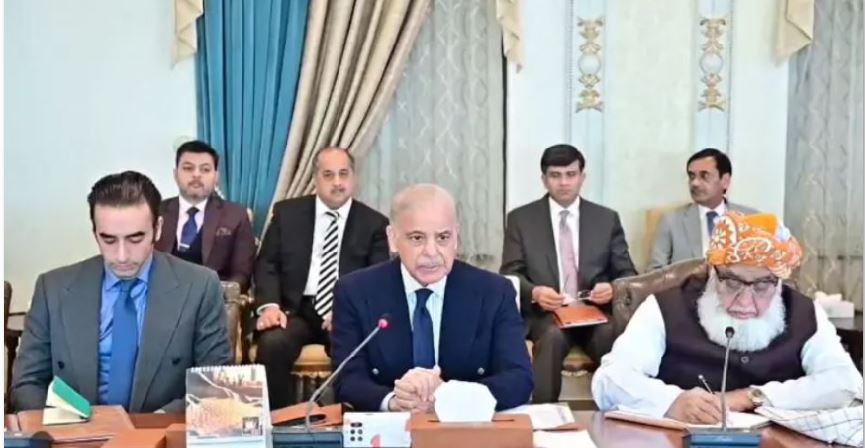
ISLAMABAD: The leaders of parliamentary parties, led by Prime Minister Shehbaz Sharif, were on Wednesday given an in-camera briefing on the regional situation, including US-Israel attacks on Iran and Operation Ghazab lil-Haq’ against the Taliban government.
The briefing began shortly after 11:30am at the Prime Minister House and concluded after more than two hours.
PPP Chairman Bilawal Bhutto-Zardari and Jamiat Ulema-i-Islam–Fazal (JUI-F) chief Maulana Fazal Rehman were among prominent politicians who attended the briefing.
Other party leaders included Khalid Maqbool Siddiqui from the Muttahida Qaumi Movement-Pakistan (MQM-P), Abdul Aleem Khan from Istehkam-i-Pakistan Party (IPP), Khalid Hussain Magsi from Balochistan Awami Party (BAP) and PML-Q’s Chaudhry Salik Hussain.
Senate Chairman Yousaf Raza Gilani, NA Speaker Sardar Ayaz Sadiq, Senate Deputy Chairman Syedal Khan Nasar and NA Deputy Speaker Ghulam Mustafa Shah were also present in the meeting.
However leaders of the Tehreek Tahafuz Ayeen-e-Pakistan (TTAP), including opposition leaders in the National Assembly and Senate Mahmood Khan Achakzai, Raja Nasir Abbas and PTI Chairman Barrister Gohar Khan, skipped the high-level meeting due to the political differences with the rulling elite.
“The meeting was given an in-camera briefing regarding the Pakistan-Afghanistan situation, the hostilities in Iran, Middle East and the Gulf, and Pakistan’s diplomatic efforts,” read a statement from the PM Office (PMO).
It added that the parliamentary leaders of the participating political parties “freely expressed their views”.
“The participants underscored the need for national unity, consensus and unanimity in the current circumstances,” the PMO statement said.
It noted that the attendees hailed Pakistan’s diplomatic efforts for peace, stressed the need to intensify them and made recommendations for the future plan of action.
“All participants reiterated their firm commitment for the eradication of terrorism from the country,” PMO stated, adding that the leaders also hailed PM Shehbaz’s “move to take the entire political leadership into confidence”.
While the ruling PML-N had extended the olive branch to the PTI and invited it to sit together for the sake of external and internal security threats to Pakistan, the PTI decided not to attend any meeting unless a meeting with its founder, Imran Khan, was arranged.
Talking to a private TV channel after the meeting, PM’s Adviser on Political Affairs Rana Sanaullah provided some insight into the briefing’s discussions.
He highlighted that Pakistan’s efforts on the diplomatic front were that “this war imposed on Iran ends in some kind of agreement or understanding”.
Asked whether Saudi Arabia and Iran were in direct contact with each other or Islamabad was acting as a mediator, Sanaullah stated, “Pakistan is doing this work of communication.”
He pointed out that the political and military leadership have made contacts regarding the ongoing hostilities, and it was also stated in the briefing that they were trying to convince Iran not to attack Gulf countries.
Sanaullah noted that if the attacks on Gulf countries stop and “those countries also add their weight that this war should end”, then there would be greater chances of an agreement to end the hostilities.
About whether the Middle Eastern countries could push US to halt its attacks, the senator said a “strategy” was being carved out, with various leaders, including former foreign minister Bilawal, giving their recommendations.
The minister further said that “engagement was underway to seek clarity” on Iran’s concerns of Gulf countries’ territory being possibly used for strikes against it.
Responding to a question, Sanaullah said the political and military leadership were engaged in communication to “resolve misunderstandings” and halt retaliatory attacks from Iran directed towards Gulf countries.
About arch-enemies Iran and Israel, the senator affirmed that Iran “definitely has the right to respond to aggression done against it”, adding that leaders voiced the same opinion in today’s meeting.
He said PM Shehbaz and Dar were making efforts so that “Iran’s response to other Muslim and Gulf countries […] this matter does not happen, else it would further weaken Muslim countries’ alliance”.
Asked whether Operation Ghazab lil-Haq came under discussion in today’s in-camera briefing, Sanaullah said, “Pakistan’s goals, strategic planning and the achievements Pakistan seeks have almost been achieved. Now, they are being fortified.”
The PM’s adviser, also the inter-provincial coordination minister, stressed that Pakistan’s only demand was that Afghan Taliban “do not allow their soil to be used for terrorism against us”.
“We want a bufferzone in between, which could even be jointly monitored by both countries or our friendly nations could be bothered for it,” he said.
Speaking about the opposition’s decision to skip the important briefing, Sanaullah expressed disappointment at the opposition’s “attitude of isolation”, adding that the PTI did not believe in dialogue.
Sanaullah recalled that he and the parliamentary affairs minister met NA Opposition Leader Mahmood Khan Achakzai and PTI Chairman Gohar Ali Khan in the opposition’s chamber yesterday to invite them.
“I requested them that this is a national issue. Our party politics is at its place but we should sit together on this and you should give your opinion on this and contribute,” he quoted himself as telling Achakzai and Gohar.
The PM’s adviser said the PTI’s meeting with Imran was “not possible today, but in the future, in fact we also told them that if you would contribute sincerely towards a national issue, then there could also be ease in rest of the things”.
“If they would have come and played their national role … they could have also touched upon that topic,” he added.
Sanaullah noted that Senate Opposition Leader Raja Nasir Abbas was “very positive” about it, but said the political committee would have they final say, which then decided to boycott the briefing. Staff Report