Pakistan making ‘full diplomatic efforts’ to de-escalate situation in Middle East, says Dar
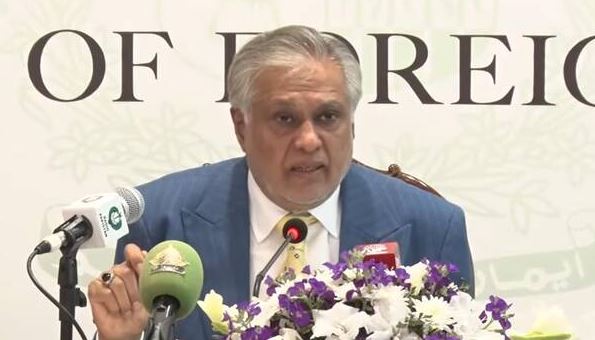
ISLAMABAD: Deputy Prime Minister and Foreign Minister Ishaq Dar on Monday said Pakistan was making “full diplomatic efforts” to de-escalate the regional situation following attacks by the United States and Israel on Iran.
“This recent escalation … has … significantly heightened tensions in an already volatile and fragile environment. We are making full diplomatic efforts and requesting all parties to de-escalate,” Dar said during a media briefing in Islamabad.
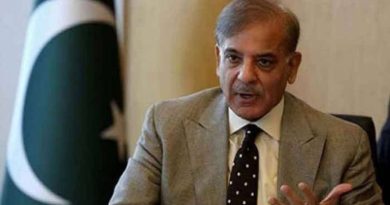
He recalled Prime Minister Shehbaz Sharif’s visit to Austria and noted that he held discussions with the International Atomic Energy Agency (IAEA), saying that the “feedback was positive”.
He said that “serious developments” had taken place at a time when “diplomatic efforts were underway to reach a peaceful and negotiable … solution”.
“But what triggered all of a sudden engulfed … almost all countries,” he said.
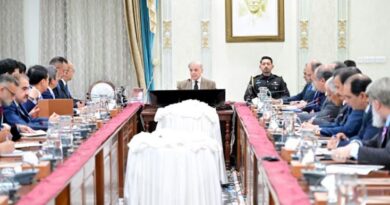
He then referred to a high-level meeting chaired by the prime minister on Sunday, which reviewed the regional environment and the situation between Pakistan and Afghanistan.
Commenting on the assassination of Iran’s Supreme Leader Ayatollah Ali Khamenei and said: “We are concerned over the violation of norms as well as international law … that the heads of state and the government … have been targeted.”
The foreign minister said Pakistan had consistently urged that the door to dialogue and diplomacy must not be closed.
“Pakistan’s position has been clear and persistent that all countries must abide by the principles of the UN Charter and international law, including respect for the sovereignty and territorial integrity of other states, as well as international humanitarian law,” he said.
He also referred to his conversation with Iran’s Foreign Minister Abbas Aragchi last week and said, “I conveyed Pakistan’s condemnation of the attacks, called for diplomacy, restraint and dialogue, to which he positively responded.”
However, he said, on the ground, things were not settling down.
The foreign Minister also talked about the emergency meeting of the United Nations Security Council (UNSC) held on the situation in the Middle East, saying “Pakistan’s permanent representative at the UN also reiterated Pakistan’s condemnation of the attack on Iran.”
The deputy prime minister further stated that he spoke with the foreign ministers of several countries in this regard.
“I think I have not talked to anyone who disagrees that dialogue and diplomacy are the only way forward, not only for this region but wherever there is any conflict,” he said.
“Pakistan also stands in full solidarity with all our brotherly countries and underscores the need to exercise maximum restraint,” he said, adding that this was the message Pakistan’s leadership was giving in conversations with others.
He acknowledged that while Iran’s retaliatory strikes were in self-defence, Pakistan regretted and condemned the strikes against Saudi Arabia, Bahrain, Jordan, Kuwait, Qatar, and the United Arab Emirates and Oman.
“We can’t have double standards,” he said. He said that while Iran had stated that it had attacked US bases in these countries, there was “no justification”.
He reiterated that the prime minister had also expressed deep regrets on the situation and called the leadership of the brotherly countries and requested them to exercise restraint.
“Developments in the last 72 hours [are] really very, very worrisome,” he said.
“In our outreach, at the leadership level, we have called for an immediate halt to escalation through the urgent resumption of diplomacy to achieve a peaceful, negotiated resolution to the crisis,” he said.
“Pakistan stands ready to extend support towards the peaceful resolution of outstanding issues,” he said. Staff Report