Pakistan, Philippines agree to boost multi-sector cooperation
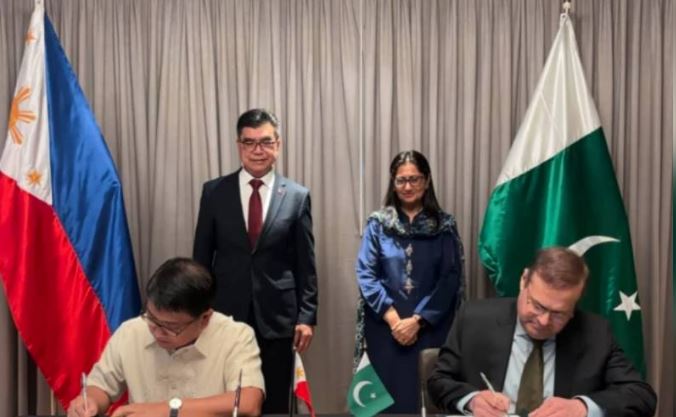
ISLAMABAD: Pakistan and the Philippines, at the second meeting of their Joint Economic Commission held in Manila, agreed to enhance cooperation across multiple sectors and reaffirmed their commitment to strengthening economic engagement through practical and result-oriented initiatives.
The Meeting was co-chaired by Secretary Economic Affairs Division, Muhammad Humair Karim Kidwai and Undersecretary for International Trade of the Department of Trade and Industry Philippines, Atty. Allan B. Gepty, according to press release issued by Economic Affairs Ministry here Friday.
The meeting was attended by Dr. Asima Rabbani, Pakistan’s Ambassador to the Philippines, and Dr. Emmanuel R. Fernandez, Philippine Ambassador to Pakistan, along with senior officials of both sides.
Both sides exchanged views on the global economic environment and shared updates on their respective economic outlooks and trade policy priorities. The two sides reviewed bilateral trade and investment relations and acknowledged the considerable untapped potential for expansion. Pakistan highlighted export prospects in agricultural goods and halal-certified products, and proposed business exchanges, trade fairs, as well as a dedicated business forum.
Both sides underscored the importance of private sector engagement and supported the reactivation of the Pakistan-Philippines Joint Business Council. Pakistan proposed enhanced investment cooperation, including MoU between the respective Boards of Investment and the establishment of a Joint Working Group on Investment.
Discussions were also held on market access issues, with Pakistan emphasizing early resolution of its pending requests and both sides agreeing to continue engagement through established channels.
The possibility of exploring a Preferential Trade Agreement (PTA) was welcomed, with both sides agreeing that feasibility studies would guide future discussions. The existing JEC framework may be strengthened to incorporate expanded sectoral cooperation.
Sectoral discussions covered agriculture, irrigation and water management, halal development, health and pharmaceuticals, banking and taxation, higher education and TVET, energy and minerals, tourism, and visa facilitation. In agriculture, both sides emphasized cooperation in seed development, plant variety protection, quality assurance, and community-based irrigation initiatives. On halal development, the focus was on compliance training, certification exchanges, and strengthening supply chain capabilities.
In health and pharmaceuticals, the two sides discussed structured collaboration through a dedicated working group, including regulatory cooperation and facilitation of pharmaceutical and medical device trade. In banking and taxation, discussions highlighted collaboration in digital payments, remittance corridors, financial innovation, supervisory cooperation, and consideration of updating the Double Taxation Agreement in line with modern standards.
Both sides also expressed interest in expanding partnerships in higher education and TVET through academic exchanges and skills development initiatives, as well as in energy and minerals through upstream exploration, mining technology exchange, and investment opportunities. Cooperation in tourism promotion and capacity building was encouraged, while the importance of efficient and predictable visa procedures, particularly for business travel, was underscored to facilitate trade and investment flows. APP