LUMS, American Business Forum host high-level policy dialogue on Pakistan’s economic future
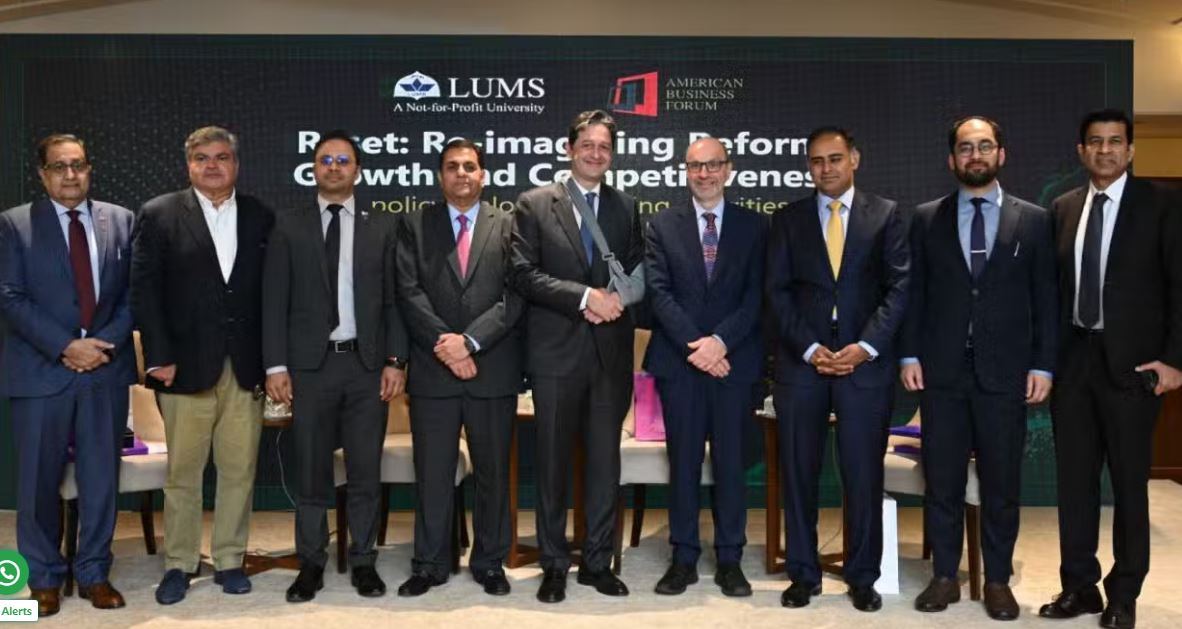
ISLAMABAD: At a critical juncture for Pakistan’s economy, the Lahore University of Management Sciences (LUMS) and the American Business Forum (ABF) jointly hosted a high-level policy dialogue in Islamabad to examine pathways toward sustainable growth, export competitiveness and long-term economic resilience.
The session brought together senior policymakers, economists, business leaders, academics and members of the diplomatic community to deliberate on structural bottlenecks and reform priorities.
Delivering the keynote address at the session titled “Reset: Re-imagining Reform, Growth and Competitiveness,” Professor Stefan Dercon, development economist at the University of Oxford and author of Gambling on Development, said Pakistan’s recent stabilisation efforts were commendable but fragile. “Once this economy grows beyond 4%, with its current structure, Pakistan will require another IMF programme,” he said, stressing that sustainable growth hinges on structural reform, export expansion and improved regulatory quality.
Noting that exports remain at around 10% of GDP and private investment below potential, he warned that growth without reform could revive balance-of-payments pressures. He also advised against short-term fiscal stimulus, arguing that across-the-board tax cuts without structural adjustment would deliver only temporary relief.
“Structural reform means reallocating capital toward competitive, export-oriented sectors rather than protected domestic markets,” he added.
Minister of State for Finance and Railways, Bilal Azhar Kayani, acknowledged the need for policy coherence and continuity. Referring to the National Tariff Policy and ongoing privatisation initiatives, he emphasised the importance of reducing distortions and encouraging private-sector-led growth.
“The government must reduce its footprint, not only in regulation but also in ownership. We must unlock the private sector rather than attempt to pick winners,” he said, while underscoring the importance of long-term planning and avoiding policy reversals.
Representatives from the private sector stressed that regulatory consistency and predictable policy frameworks are central to investor confidence. Participants observed that while tariff reforms may face resistance, they are essential for integrating Pakistan into global value chains and enhancing competitiveness.
During the session, ABF leadership emphasised that Pakistan must move beyond incremental budgetary adjustments and focus on deeper structural transformation to break recurring cycles of stabilisation and crisis. The discussion also touched on industrial policy, digital transformation and the need to move away from excessive protectionism. Participants noted that while tariff reforms may face resistance from certain sectors, they are necessary to integrate Pakistan more effectively into global value chains. Staff Report