Pakistan stuck in economic cycle due to governance flaws: Miftah Ismail
KARACHI: Former finance minister Miftah Ismail has said that Pakistan remains trapped in an economic cycle due to structural governance issues.
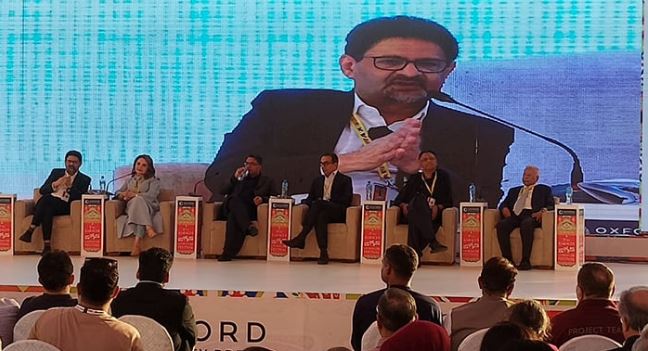
Speaking during a session at the Karachi Literature Festival, the former finance minister stressed that eliminating terrorism is necessary to create an environment conducive to growth.
The session, titled “Fixing the Fundamentals: Pakistan’s Economic Reform”, brought together prominent policymakers, economists, and business leaders to discuss Pakistan’s economic challenges and the immediate need for structural reforms.
The discussion centered on moving beyond short-term fixes and adopting a consistent, long-term strategy to stabilise and grow the economy.
The session was moderated by Muhammad Azfar Ahsan, former minister for investment. The speakers included Muhammad Ali, Dr Ishrat Husain, Ismail, Asad Umar, and Dr Zeelaf Munir. They agreed that Pakistan’s economic problems cannot be resolved through temporary or tactical measures.
Adviser to the Prime Minister on Privatisation Ali emphasised that reform must begin at the structural level, particularly by documenting the economy to strengthen the taxation system. He stated that sustainable growth is not possible without proper economic documentation and tax reform.
He also called for reducing the government’s footprint in commercial activities, arguing that running businesses is not the government’s role and that state involvement contributes to high electricity and gas prices. He stressed the importance of expanding exports, increasing women’s participation in the workforce, and empowering local governments to improve service delivery and governance.
Economist, author, and former State Bank of Pakistan (SBP) Governor Dr Husain highlighted Pakistan’s external debt burden of $25 billion and noted that the country requires approximately $12 billion annually to manage its debt obligations.
According to him, Pakistan spends around $10 billion each year on food imports, a figure that could be significantly reduced by strengthening domestic agriculture. Providing farmers with targeted support, better access to credit, modern farming techniques, and improved supply chains would enhance food security, reduce pressure on foreign exchange reserves, and improve rural livelihoods.
Dr Husain also emphasised the need to reduce dependence on raw materials and imported goods by investing in industries such as steel, petrochemicals, pharmaceuticals, and lithium batteries, while shifting greater focus towards services and innovation-driven sectors.
Pakistan Business Council Chairperson Dr Munir stressed that credibility and policy consistency are necessary to attract investment. Staff Report