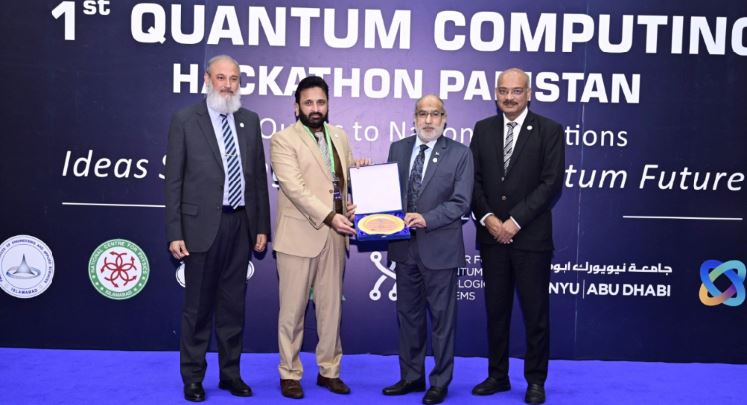
Pakistan launches its first-ever National Quantum Computing Hackathon
Major technological milestone achieved
ISLAMABAD: Pakistan has achieved a major technological milestone with the launch of its first-ever National Quantum Computing Hackathon, aimed at strengthening national capabilities in emerging technologies and nurturing the next generation of scientific innovators. The event was inaugurated at the National Centre for Physics (NCP) on Friday.
Chairman Pakistan Atomic Energy Commission (PAEC), Dr. Raja Ali Raza Anwar, inaugurated the hackathon as Chief Guest and described the initiative as a strategic step toward positioning Pakistan among future global leaders in advanced science and technology.
Addressing participants, Dr. Anwar said quantum science is rapidly transitioning from theoretical research to practical applications in critical sectors such as national security, healthcare, energy, materials science, finance, and data protection. He emphasized that early investment in human capital will determine technological leadership in the coming decades, adding that initiatives like the hackathon are essential for building a robust national quantum ecosystem.
Dr. Anwar congratulated the organizing institutions — National Institute of Lasers and Optronics (NILOP), Pakistan Institute of Engineering and Applied Sciences (PIEAS), and National Centre for Physics (NCP) — for bringing together young talent, researchers, and mentors on a unified platform. Highlighting PAEC’s longstanding contributions to scientific development, he noted that the Commission has played a central role in advancing nuclear technology, materials research, and medical applications, and that the hackathon reflects PAEC’s commitment to innovation-driven sustainable progress.
The PAEC Chairman stressed that participating students and young researchers represent Pakistan’s future scientific leadership and called for interdisciplinary collaboration among experts in physics, mathematics, and computer science to develop solutions aligned with national priorities. He said the hackathon is the beginning of a long journey of innovation and that true progress comes from bold inquiry, exploration, and collective problem-solving for societal benefit.
He further noted that the challenges designed for the hackathon address real-world societal needs, ensuring emerging technologies contribute to inclusive national development. Dr. Anwar also acknowledged the role of mentors, judges, and technical experts in guiding innovative projects and shaping future scientific leaders. Emphasizing the strategic importance of quantum technologies, he said the government considers the domain critical for national development and security.
Earlier, Member Science PAEC Dr. Shakeel Abbas Rofi highlighted the practical and creative aspects of the hackathon, stating that quantum computing is no longer a theoretical possibility but an inevitable technological reality. He encouraged participants to view real-world challenges as opportunities for innovation and urged them to experiment, innovate, and transform ideas into impactful solutions.
Representing the Open Quantum Institute (OQI), CERN, Martin Gastal praised Pakistan’s growing role in quantum research and highlighted CERN’s educational opportunities, including internships for students and educators. He said quantum computing complements conventional computing and can help address global challenges in support of the Sustainable Development Goals. He also encouraged Pakistani students and researchers to engage with CERN and contribute to global scientific innovation. The event concluded with congratulations to the finalists and encouragement for participants to uphold integrity, collaboration, and excellence in their scientific pursuits.۔ Syed Naveed Jamal