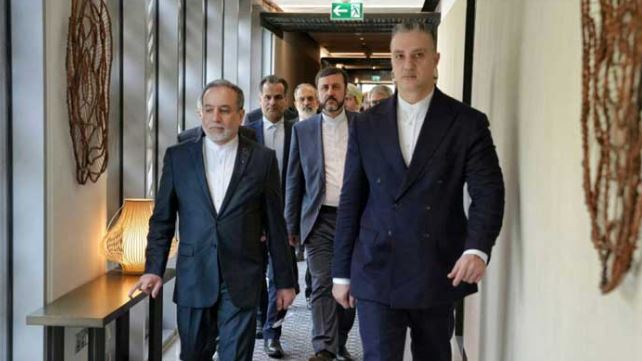
Iran, US nuclear talks in Oman were a good start, says FM Araghchi
MUSCAT: High-stakes nuclear talks between Iran and the United States held in Oman on Friday were a good beginning and will continue, Iranian Foreign Minister Abbas Araqchi said.
“It was a good start to the negotiations. And there is an understanding on continuing the talks. Coordination on how to proceed will be decided in the capitals,” Araqchi told Iranian state TV.
Officials from both sides will return home for consultations and “the wall of mistrust” should be overcome, he added.
Iranian Foreign Ministry spokesperson Esmaeil Baghaei also said that talks between Iran and the United States in Oman concluded with an agreement to continue negotiations.
“The parties, while explaining their perspectives and demands, reached an understanding to make decisions regarding the next round of talks in consultation with their capitals,” Baghaei said in a post on X.
While both sides have signalled readiness to revive diplomacy over Tehran’s long-running nuclear dispute with the West, Washington wants the talks to cover Iran’s nuclear programme, its ballistic missiles, support for armed groups around the region and its “treatment of their own people”, US Secretary of State Marco Rubio said on Wednesday.
Iran has said it wants Iran’s Foreign Minister Abbas Araghchi and US Middle East envoy Steve Witkoff to discuss only nuclear issues in Muscat.
Iran’s foreign minister called on Friday for “mutual respect” ahead of talks with the United States on the Islamic republic’s nuclear programme and other issues.
“Iran enters diplomacy with open eyes and a steady memory of the past year. We engage in good faith and stand firm on our rights,” Abbas Araghchi wrote on X.
“We hope the American side will also participate in this process with responsibility, realism and seriousness,” Baghaei said on Thursday.
Tehran’s leadership remains deeply concerned that US President Donald Trump may still carry out his threats to strike Iran amid a buildup by the US Navy near Iran.
The US naval buildup, which Trump has called a massive “armada”, has followed a bloody government crackdown on nationwide protests in Iran last month, heightening tensions between Washington and Tehran.
White House Press Secretary Karoline Leavitt on Thursday told reporters that Trump was looking to determine whether a deal can be struck but also issued a warning.
“While these negotiations are taking place, I would remind the Iranian regime that the president has many options at his disposal, aside from diplomacy as the commander in chief of the most powerful military in the history of the world,” she added.
Trump has warned that “bad things“ would probably happen if a deal could not be reached, ratcheting up pressure on the Islamic Republic in a standoff that has led to mutual threats of airstrikes.
Iran has warned it would respond harshly to any military strike and has cautioned neighbouring countries hosting US bases that they could be in the firing line if they were involved in an attack.
“It’s very difficult to see them conceding enough in talks tomorrow for the US credibly to be able to claim that it’s made a breakthrough. And this is where I think, military conflict is more likely than not,” Edmund Fitton-Brown, senior fellow at Washington-based think-tank FDD, said. Hours before the talks, Iran’s state TV said that “one of the country’s most advanced long-range ballistic missile Khorramshahr 4” has been deployed at one of the Revolutionary Guards’ vast underground missile complexes. Monitoring Desk