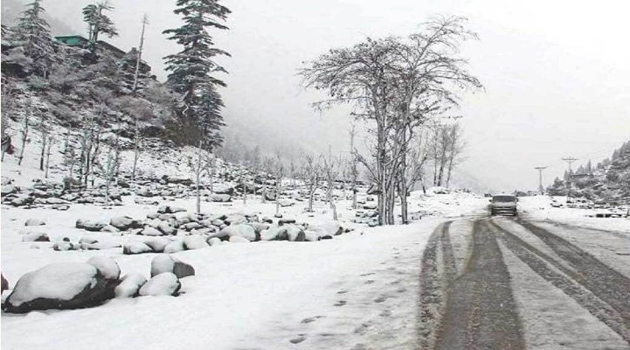
From Malam Jabba to Kalam: Hotels in Swat Valley overflow amid heavy snowfall
SWAT: The hotel industry in the scenic Swat valley has witnessed a remarkable revival as moderate to heavy snowfall transformed the region into a winter wonderland, drawing thousands of tourists and breathing new life into local businesses.
From Mingora to Kalam, Saidu Sharif to Malam Jabba, hotels, restaurants, and even roadside in Swat remained fully occupied as snowfall lovers poured into the valley to enjoy the breathtaking white landscapes.
The sudden surge in visitors came as a welcome relief for hoteliers who had been grappling with low occupancy rates earlier this winter.
For years, Swat’s winter tourism has been associated with skiing, snowboarding, and peaceful mountain retreats. This season, however, the fresh spell of snowfall significantly boosted tourist inflow, particularly in popular destinations such as Kalam, Madain, and Malam Jabba, where hotels were jam-packed.
“The recent snowfall attracted tourists to Swat in large numbers, and almost all hotels are fully booked,” said Rizwan Khan, hotel manager at Swat Continental in Mingora. “This has helped the hospitality sector recover after a sluggish start to the winter season.”
The tourism boom has not only benefited hotels but also provided livelihoods to tour operators, horse riders, photographers, and local vendors, all of whom reported increased earnings as tourists thronged snowfall hotspots.
According to the Meteorological Office, Pakistan receives an average annual rainfall of 267.6mm, with forested regions such as upper Punjab and Khyber Pakhtunkhwa typically experiencing higher precipitation.
Experts said the recent heavy snowfall will help regulate temperatures and play a crucial role in strengthening the lifespan of glaciers in Swat, Chitral, and Gilgit-Baltistan.
Engr Fakhre Alam Khan, Spokesman for the Small Dams Wing of the Irrigation Department, said the snowfall would enhance glacier sustainability and ensure sufficient water flow to rivers and dams during the summer months.
“Pakistan is blessed with more than 24 large and small rivers, including five in Punjab, four in Sindh, eight in Khyber Pakhtunkhwa, and seven in Balochistan,” he said, adding that the country has immense potential for constructing small, medium, and large dams at various sites to store water.
He highlighted key locations such as Diamer-Bhasha, Dasu Kohistan, Kalabagh on Indus River, Mohmand and Kalam on the Swat River, Shalman Khyber on the Kabul River, Tangi on the Kurram River, and Kaghan-Naran on the Kunhar River as suitable sites for dam construction.
Engr Fakhre Alam said that small dams could be completed within two to three years, while large dams typically require 10 to 15 years.
He added that Pakistan would need an additional 76 million acre-feet (MAF) of water by 2050, which could only be achieved through the construction of small and medium dams.
He said that 37 small and medium dams have already been constructed in Khyber Pakhtunkhwa, including 15 operated by the provincial government, 11 supervised by WAPDA, and 10 built in the merged districts.
These dams cover 0.1377 million acres of cultivated command area (CCA) and have a combined water storage capacity of 0.3414 acre-feet (AF).
Currently, 24 small dams with a cumulative storage capacity of 75,008 AF and covering 49,523 acres of CCA are under construction across KP under the federal government’s Public Sector Development Programme (PSDP).
In addition, several dams—including Pezu Dam in Lakki Marwat, Khattak Bandhan Dam in Kohat, and Makh Banda Dam in Karak—have been completed, while others such as Ichar and Manchura dams in Mansehra, Chashma Akora Khel in Karak, Sarozai in Hangu, Sanam in Lower Dir, and Bada and Ulta dams in Swabi were jointly developed by the federal and provincial governments.
Engr Fakhre Alam further disclosed that seven medium dams, including Bara Dam in Khyber, Tank Zam in Tank, Sheikh Haider Zam, Chaudwan Zam, Daraban, Kora Nullah in Dera Ismail Khan, and Larzan Small Dam in Tank, are currently in the design phase.
These projects will have a combined water storage capacity of 520,884 AF, irrigate 171,748 acres of land, and generate 31.5 megawatts of electricity once completed.
“I came to Malam Jabba to enjoy snow sports,” said Riaz Khan, a tourist of Peshawar.
As children playing snowballs around him at Malam Jabba, Riaz enjoys Chappli Kabab with family to best bitting cold.
He said hotel charges are sky high in Malam Jabba that needed to be checked by the district administration.
Riaz suggested increasing number of camping pods in Malam Jabba and Kalam for affordable accommodations to tourists.
As snow continues to blanket the valley, Swat not only stands rejuvenated as a top winter tourism destination but also highlights how natural weather cycles can positively impact both local economies and long-term water sustainability.