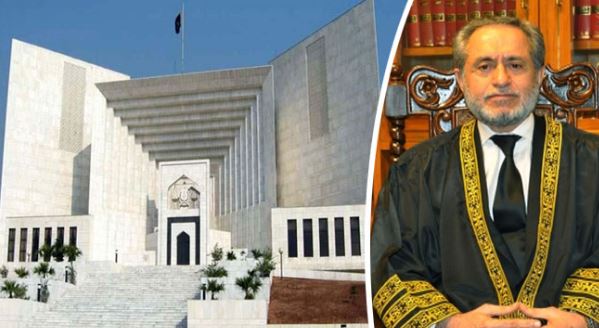
SC affirms state’s duty to protect right to life, prevent custodial violence
ISLAMABAD: The Supreme Court, in a case concerning the custodial death of a citizen, upheld that the state has a duty to protect the ‘right to life’ of citizens and to prevent custodial violence and killings, it emerged on Saturday.
The case pertains to the custodial killing of Zaryab Khan, who was detained in 2020 in Punjab’s Dera Ghazi Khan, and later died in police custody. It was alleged that two officials of the Federal Investigation Agency (FIA) tortured the detainee and caused his custodial death. They were later acquitted by a criminal court but were dismissed from service over misconduct by the regional police officer. Subsequently, they filed an appeal with the SC, arguing that the dismissal is “baseless” if they have been acquitted in the case.
In a seven-page judgment, authored by Justice Jamal Khan Mandokhail, SC dismissed the petitions and upheld the earlier ruling.
“The Constitution imposes a duty upon the State to protect the right to life of every citizen and to prevent custodial violence and killings.”
The judgment is dated August 21.
“The right to life has been categorised as the supreme human right, which is codified in every major human rights treaty,” Justice Mandokhail stressed.
“These Constitutional guarantees against illegal detention, arrest, brutality, torture and extra-judicial killings in any form are bedrock legal and fundamental principles enshrined in the Constitution; therefore, illegal detention and torture are neither encouraged nor justified under any circumstances,” he said.
Justice Mandokhail ruled that “torture and other cruel, inhumane, or degrading treatment, including outrages upon personal dignity are not permitted in any circumstance, as it is against human dignity and the rule of law.”
He noted that at times “torture led to extrajudicial killings by the police, presuming de facto impunity and as a means of bringing [the] alleged criminal to justice”.
The judge also called for an “effective, dedicated, external” oversight of the police, terming it “the need of the hour”.
Justice Mandokhail highlighted that, according to the Universal Declaration of Human Rights (UDHR), “everyone is entitled to rights and freedom without discrimination, including the right to life, liberty, and security of person, and protection from torture, slavery, and degrading treatment”.
Citing Article 4 of the Constitution, the ruling stated that “no action detrimental to the life, liberty, body, reputation or property of any person shall be taken, save in accordance with law.”
“Protection of law and to be treated in accordance with the law is the inalienable right of every citizen,” Justice Mandokhail ruled.
He went on to say: “Article 10 of the Constitution provides safeguards as to arrest and detention of a person.
“It mandates that no person who is arrested shall be detained in custody without being informed of the grounds of such arrest and shall be produced before the Magistrate within a period of 24 hours of such arrest.”
Justice Mandokhail, citing Article 14 of the Constitution, further stated that it stipulates that “the dignity of a man, and subject to law, privacy of home shall be inviolable. It further mandates that no person shall be subjected to torture”. He stressed that the individual must be allowed due process, calling it a “fundamental right”. Monitoring Desk