Pakistan renews call for climate finance, technology transfer at COP30 side events
ISLAMABAD: Pakistan has renewed its call for urgent, predictable and equitable climate finance, enhanced technology transfer and stronger international cooperation to support climate-vulnerable countries, during a series of high-level side events organized by the Ministry of Climate Change and Environmental Coordination (MoCC&EC) on the sidelines of the UN Climate Summit (COP30) in Belem, Brazil.
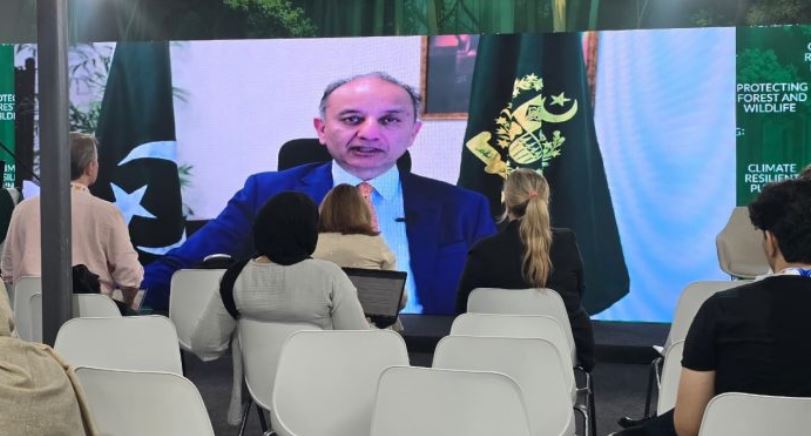
The sessions, addressed by Federal Minister for Climate Change Senator Dr Musadik Masood Malik, Minister of State Shezra Mansab Kharal and MoCC&EC Secretary Aisha Humera Moriani, drew participation from negotiators, global agencies, scientific institutions and civil society.
MoCC&EC spokesperson Mohammad Saleem Shaikh told APP on Saturday that the events served as a platform to highlight Pakistan’s climate vulnerabilities, adaptation priorities and ongoing initiatives, while strengthening the country’s diplomatic voice on climate justice and governance reforms.
Secretary Aisha Humera Moriani, who led Pakistan’s coordination efforts at COP30, said the ministry aimed to present a climate narrative backed by evidence and clear policy direction.
She noted that Pakistan’s pavilion had become a focal point for discussions on adaptation needs of developing nations and the importance of support systems tailored to “the realities of those most at risk.”
The side events, she added, reflected the country’s push to showcase practical solutions, including early warning systems, watershed rehabilitation, vocational upskilling and climate-smart transitions. “Pakistan’s experience has demonstrated that resilience is achievable when science, institutions and financing move in the same direction,” she said.
At a session on “Cryosphere Adaptation and Disaster Risk Reduction,” Pakistan warned that accelerating glacial melt in the Hindu Kush–Karakoram–Himalaya region posed mounting risks to rural communities, infrastructure, agriculture and the economy.
Senator Malik said that despite contributing less than one per cent of global emissions, Pakistan faced severe climate impacts such as glacial lake outburst floods (GLOFs) and hydrological disruptions.
He urged the creation of dedicated disaster-risk financing windows—particularly anticipatory financing—to help communities prepare before climate shocks escalate.
Minister Kharal called for a regional scientific cooperation platform for high-mountain risk assessment, emphasizing satellite monitoring, climate modeling and improved early-warning systems. “Adaptation must be resourced at the same scale as climate losses,” she said.
International experts agreed that cryosphere research remained severely underfunded and that frontline states required predictable long-term financing for disaster-proof infrastructure, watershed restoration and nature-based solutions.
A separate high-level dialogue on “Building Green Skills for a Climate-Compatible Pakistan” focused on preparing the national workforce for the global transition to renewable energy, circular production, electric mobility and climate-smart agriculture.
During a dialogue on climate finance, Pakistan reiterated that ambitious climate action remained impossible unless developed countries delivered on their Paris Agreement commitments.
Senator Malik said climate finance must move from “promises to predictable disbursements,” with simplified access and rapid deployment for disaster-prone developing countries.
He stressed that the Loss and Damage Fund should be fully capitalized and primarily offer grants and concessional finance rather than loans that worsen debt burdens.
Minister Kharal urged the global finance system to fairly value resilience and ecosystem services, saying countries protecting forests, watersheds and biodiversity should not be economically penalized. Adaptation, she said, must be measured in both economic and ecological terms. APP