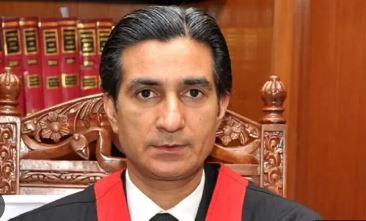
Justice Shams Mehmood Mirza resigns from LHC following 27th Amendment
LAHORE: Justice Shams Mehmood Mirza on Saturday tendered his resignation as a judge of the Lahore High Court (LHC), becoming the first judge to resign from any high court after the contentious 27th Constitutional Amendment was enacted into law.
His resignation letter, his family sources said, stated that in light of the latest amendment to the Constitution, he could not continue in good conscience.
Justice Mirza was appointed as an additional judge of the LHC in March 2014, and his superannuation was due on March 6, 2028.
He is the son of late Justice Zia Mehmood Mirza, a former Supreme Court judge who delivered the famous and only dissenting opinion among seven judges in the case pertaining to the dismissal of Benazir Bhutto’s government by then-president Farooq Ahmad Khan Laghari in 1996. The judge had held that Laghari’s move was unjustified and there was no evidence suggesting there was a breakdown of constitutional order to justify exercising his powers under Article 58(2)(b), which allowed the president to dismiss the elected government and which was ultimately removed in the 18th Amendment.
A press release from the LHC Bar Association (LHCBA) said its officeholders paid tribute to the judge for his resignation and criticised the 27th Constitutional Amendment for having “divided the higher judiciary into pieces” and being responsible for the “burial of the Constitution”.
The LHCBA called on other judges who took oath under the Constitution to also resign from their posts, saying the entire legal community would respect them for the move.
The association also announced observing a strike on Monday, saying that lawyers would completely boycott court proceedings after hearings of urgent cases.
Justice Mirza’s resignation comes two days after the passage of the contentious 27th Amendment, which has been assailed as a “flagrant attack” on judicial independence by the International Commission of Jurists (ICJ).
The move also follows the resignations of the Supreme Court’s senior puisne judge, Justice Mansoor Ali Shah, and Justice Athar Minallah, both of whom wrote strongly worded resignation letters censuring the 27th Amendment.
Amid speculation about possible transfers of high court judges, Justices Mohsin Akhtar Kayani and Saman Rafat Imtiaz of the Islamabad High Court (IHC) have hinted they might not be available to hear cases in the federal capital from next month.
27th Amendment and its impact on judiciary
The 27th Amendment, besides bringing changes in other domains, alters the judiciary’s functioning in two areas — constitutional matters and the transfer of judges.
The legislation empowers the Judicial Commission of Pakistan to transfer high court judges without their consent — a provision that has raised concerns within sections of the judiciary.
The most notable decision made by the ruling coalition is the formation of the Federal Constitutional Court (FCC), which experts say has dethroned the Supreme Court as the country’s highest judicial forum. The reason for those concerns is that the FCC will now deal with crucial constitutional matters and its decisions would be binding on all courts, including the SC itself. Under the new Article 189, the SC would be downgraded to the apex court for civil. Monitoring Desk