UN food agencies warn of 16 hunger hotspots — 4 of the top 6 are Middle East countries
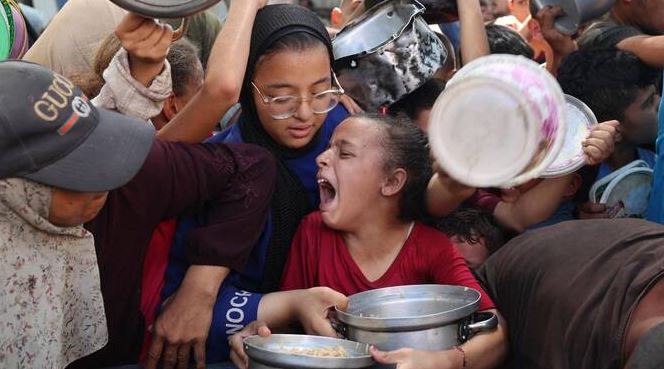
ROME: Two UN food agencies warned Wednesday that millions more people around the globe could face famine, with funding shortfalls worsening already dire conditions.
The joint report from the Food and Agriculture Organization and the World Food Programme said conflict and violence were driving acute food insecurity in the majority of the countries identified at risk.
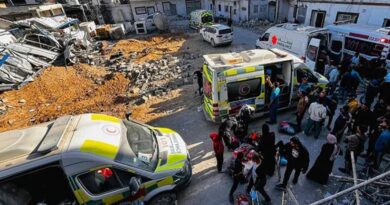
The Rome-based agencies listed Haiti, Mali, Palestine, South Sudan, Sudan and Yemen as the worst, “where populations face an imminent risk of catastrophic hunger.”
Also classified as a “very high concern” were Afghanistan, the Democratic Republic of the Congo, Myanmar, Nigeria, Somalia and Syria, with Burkina Faso, Chad, Kenya and the situation of the Rohingya refugees in Bangladesh also making the list.
“We are on the brink of a completely preventable hunger catastrophe that threatens widespread starvation in multiple countries,” said WFP Executive Director Cindy McCain, warning that a failure to act “will only drive further instability, migration, and conflict.”
Funding for humanitarian relief was falling “dangerously short,” the report said, pointing to only $10.5 billion received out of a required $29 billion to help those at risk.
WFP said that due to funding cuts, it had reduced assistance for refugees and displaced people while suspending school feeding programs in some countries.
FAO warned that efforts to protect agricultural livelihoods were threatened “which are essential for stabilising food production and preventing recurring crises.”
Funding was needed for seeds and livestock health service, it said, “before planting seasons begin or new shocks occur.”
Meanwhile, hundreds of Israelis bid farewell to army officer HadarGoldin, who was laid to rest Tuesday in the central town of Kfar Saba after Hamas returned his remains more than a decade after his death in Gaza.
Crowds packed the military cemetery, with some climbing onto rooftops to glimpse the funeral, while others filled the streets and watched on a large outdoor screen.
Blue-and-white Israeli flags fluttered in the wind, as mourners held the young lieutenant’s portrait alongside a homemade banner reading: “We will remember forever.”
Israel received Goldin’s remains on Sunday as part of an ongoing Gaza ceasefire deal brokered by US President Donald Trump that has halted the latest war.
His father, SimchaGoldin, hailed his son as a “Jewish warrior”, while urging tearful mourners to “behave righteously and do not hate one another. That is Hadar’s legacy.”
“I ask you to act the same way, and to let there be a little more of Hadar in our daily lives,” he said
HadarGoldin, 23, was killed on August 1, 2014 during a previous Israeli offensive in Gaza known as “Operation Protective Edge”.
He was leading a mission to destroy Hamas tunnels when he was killed in an ambush in Gaza’s southern city of Rafah and his body seized, just hours into a short-lived humanitarian truce, Israeli officials say.
“Today, you have returned to the land for which you fought. But we will keep returning to every place where a promise remains unfulfilled,” Israeli army chief Lieutenant General EyalZamir said in his eulogy at the funeral.
“We will fight on until every one of our sons has come home.”
On Tuesday, soldiers wearing the green uniforms and purple berets of Goldin’sGivati Brigade carried his flag-draped coffin into the cemetery.
His return closes an agonising 11-year ordeal that haunted both his family and the nation.
Leave no one behind: “Today is a hard day, but I am happy because Hadar’s coming was a dream,” Israel Blumshtein, a 76-year-old resident of Kfar Saba, told AFP, adding that he had kept a picture of Goldin in his car for six years.
He said it was important that his body be returned “because in our army… we do not leave anyone anywhere”.
Goldin’s twin brother, TzurGoldin, said Hamas’s hostage-taking sought “to weaken Israeli society, which is built on family”.
“It aims to set one family’s interests against those of the whole, to force us to decide who matters more or less, to privilege one value over another, to destroy us from within,” he continued.
“Our victory, for everyone, will be to ensure the founding principle of Israeli society — not abandoning one another, leaving no one behind — remains intact.”
At the end of the funeral, the crowd joined in singing a mournful rendition of the “Hatikvah” (The Hope), Israel’s national anthem.
Goldin’s family had held a symbolic funeral in 2014 after parts of his body were recovered from a tunnel soon after his death, but repeated attempts to retrieve the rest of his remains through previous prisoner exchanges failed.
The head of Israel’s National Center of Forensic Medicine, Chen Kugel, told AFP that Goldin’s return gave “a sense of closure, for the family… but also for the entire country”.
“Now he’s in Israel, in his home. Even if that home is a grave.” Monitoring Desk