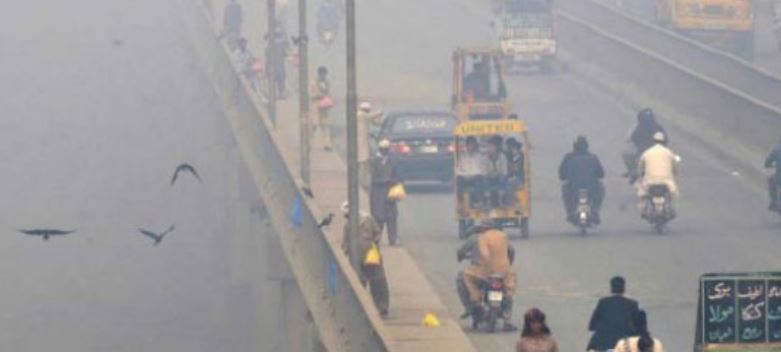
India’s diwali smog pushes Pakistan’s Air Quality to hazardous levels
LAHORE: Air pollution levels across eastern Pakistan have surged due to the Diwali festival in neighboring India, with smog drifting into Punjab’s major cities.
According to the Punjab Air Quality Monitoring Network, Lahore recorded an AQI of 318, while Dera Ghazi Khan had the highest pollution level at 450. Other major cities included Sheikhupura at 311, Faisalabad at 281, and Gujranwala at 268.
Within Lahore, AQI readings varied across the city, reaching 430 in Kahna, 379 in Shahdara, 344 on Burki Road, 336 on Multan Road, and 327 in DHA Phase 6.
Global monitoring platform IQAir reported Lahore as the world’s most polluted city, with an AQI of 298, ahead of New Delhi at 283.
In response, the Punjab government has activated anti-smog guns and launched night operations in high-pollution zones, including Thokar. The Environment Protection Department (EPD) said polluted air masses from Amritsar, Ludhiana, and Haryana are expected to affect Lahore, Faisalabad, Sahiwal, Bahawalpur, Rahim Yar Khan, and Multan, with pollution peaking early morning and at night.
Dr Zulfiqar Ali, Environmental Expert and Head of the Department of Zoology at Punjab University, said Lahore is now among the world’s top ten most polluted cities. “Air quality in the city has reached very unhealthy levels, with the AQI surging past 200, posing serious health risks to vulnerable populations,” he told a media outlet.
He attributed the crisis to a combination of local vehicle and industrial emissions, construction dust, and regional crop residue burning. “Smoke drifting into the city during the post-monsoon season, coupled with winter weather patterns such as temperature inversions and light winds, traps pollutants close to the ground,” Dr Ali said. He also noted that Lahore’s location in the Indo-Gangetic Plain makes it particularly vulnerable to cross-border pollution.
Dr Ali warned that the hazardous air, which exceeds WHO safety guidelines by more than 21 times, will persist in the coming days. “Residents should stay informed via air quality apps, seal indoor spaces, use air purifiers, limit outdoor exposure, and wear high-grade masks. Sustained improvement is unlikely without significant emission reductions and regional cooperation,” he added. The Punjab Smog Monitoring Centre advised citizens to wear masks and limit outdoor activities, especially children, the elderly, and patients with respiratory conditions. Monitoring Desk