Pakistan, Malaysia call for Gaza ceasefire, commend efforts for Palestinian statehood
KUALA LUMPUR: Pakistan and Malaysia have called for an immediate, unconditional and permanent ceasefire, an end to the blockade on Gaza, the protection of all civilians and for unimpeded flow of humanitarian assistance to those affected immediately.
The two sides also commended the international community’s efforts to find pragmatic measures in resolving the question of granting a Palestinian statehood.
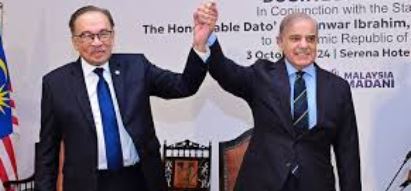
According to a joint statement issued on Tuesday at the conclusion of the three-day official visit of Prime Minister Muhammad Shehbaz Sharif to Malaysia from 5–7 October 2025, the leaders of the two countries held a bilateral meeting on 6 October 2025 to discuss bilateral ties and exchange views on regional and international issues of mutual interest.
During the meeting, they also discussed geopolitical issues, particularly the ongoing conflicts in the Middle East and the humanitarian situation in Rakhine State, Myanmar, which affects the Rohingya Muslim community. In this context, both leaders strongly condemned the ongoing genocide in Gaza and reiterated their unwavering support for the Palestinian people’s right to self-determination and the establishment of a sovereign,
viable, contiguous, and independent Palestinian state, based on pre-June 1967 borders with Al-Quds Al-Sharif as its capital.
The leaders also agreed to reconvene, at a mutually convenient time, the Joint Commission Meeting at the level of the Foreign Ministers.
They reaffirmed their commitment to promoting balanced and sustainable economic ties through enhanced market access, business facilitation, and the effective utilisation of the Malaysia–Pakistan Closer Economic Partnership Agreement (MPCEPA).
Malaysia expressed its intention to expand palm oil exports to Pakistan and also agreed to ensure a stable and sustainable supply chain, while upholding environmentally responsible practices.
They also acknowledged the growing global demand for halal products and services, and agreed to strengthen cooperation in the field of halal.
Both leaders acknowledged the importance of sustainable agricultural practices and agreed to explore joint research, innovation, and the development of sustainable agricultural production methods.
The leaders expressed satisfaction with the strong ongoing defence collaboration under the purview of the Joint Committee on Defence Cooperation (JCDC) platform, since its establishment in 1997.
Cooperation between the two countries has been tremendously strengthened through high-level visits, regular bilateral meetings at ministerial and military levels, military-to-military engagements and defence industry linkages. Both sides also agreed to further deepen the bilateral defence cooperation, particularly in the field of defence science, technology, and industry, through knowledge and technology transfer.
The two sides welcomed further cooperation in education, including technical and vocational training, and the enhancement of institutional partnerships.
Recognising the importance of aviation in fostering greater connectivity and promoting people-to-people exchanges, the leaders agreed to enhance air travel services and explore opportunities for increased connectivity between Malaysia and the Islamic Republic of Pakistan.
Efforts will focus on increasing air traffic rights to enable the expansion of flight routes and facilitating the growth of air travel, thereby strengthening economic, business, and tourism ties between the two nations.
The leaders agreed to explore collaboration in healthcare, pharmaceuticals, and medical devices, with the aim of enhancing public health and commercial exchanges in these sectors.
Both leaders expressed optimism in expanding tourism cooperation, particularly in light of Malaysia’s “Visit Malaysia 2026” (VM2026) and “Malaysia Year of Medical Tourism 2026” (MYMT2026) campaigns. Malaysia extended a warm welcome to Pakistani travelers, and the leaders agreed to enhance tourism promotion and cultural exchanges from both sides.
Both leaders recognised the importance of people-to-people ties and welcomed the positive contribution of the Pakistani diaspora in Malaysia to national development. They reaffirmed their commitment to strengthen cooperation in the area of labour, including technical training and skills development.
Acknowledging the importance of energy security and sustainability, the leaders agreed to explore cooperation in the fields of renewable energy, energy transition, and climate resilience, including knowledge-sharing, joint research and investment in clean energy projects.
Both leaders reaffirmed their support for enhanced collaboration in science, technology, and innovation (STI), including cooperation in areas such as artificial intelligence and digital transformation.
They underscored the critical importance of regional cooperation in disaster management and risk reduction, and committed to enhancing the exchange of knowledge and best practices in humanitarian assistance, emergency response, and post-disaster recovery and reconstruction.
The leaders expressed their commitment to enhance cooperation in cybersecurity and efforts in combating transnational organised crimes, terrorism, terrorism financing as well as cybercrime. They agreed to continue exchanging information and expertise to address emerging security challenges. APP