CJ Dogar-led IHC bench bars Justice Jahangiri from judicial work
Fake degree case
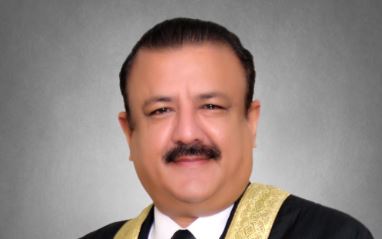
ISLAMABAD: An Islamabad High Court (IHC) bench, led by Chief Justice (CJ) Sardar Mohammad Sarfraz Dogar and comprising Justice Mohammad Azam Khan, barred Justice Tariq Mahmood Jahangiri from carrying out judicial work until the Supreme Judicial Council’s (SJC) decision on the matter of his allegedly fake degree.
A complaint pertaining to Justice Jahangiri’s allegedly fake degree was submitted to the SJC last year in July while a petition challenging his appointment was filed in the IHC earlier this year.
The matter centres on a letter that began circulating last year on social media, purportedly from the University of Karachi’s controller of examinations, regarding the judge’s law degree.
During the hearing today, apart from barring Justice Jahangiri from carrying out judicial work, the bench also appointed lawyers Barrister Zafarullah Khan and Ashtar Ausaf as amici curiae.
Moreover, the bench also sought the attorney general’s assistance over the matter of the maintainability of the plea.
It ruled that the case would remain under adjournment until the SJC’s decision on the matter.
“The court has to consider an important question, that if a matter is under adjournment in the Supreme Judicial Council, can the high court be approached on it,” the bench observed.
At one point in the hearing, Raja Aleem Abbasi, who was representing the Islamabad Bar Association, remarked, “We believe in the rule of law.” He added that bar associations were also stakeholders in the matter.
CJ Dogar observed during the hearing that anyone had the right to hearing and the court had to consider the objections on the petition by the registrar’s office.
For his part, counsel Abbasi pleaded that if the practice of filing such cases turned into trend, it could be “dangerous”. He argued that objections on the petition should be upheld.
The court concluded the hearing after ruling that Justice Jahangiri should be barred from judicial work until the SJC’s decision.
Following that, the IHC also issued a revised duty roster for the judges and does not show Justice Jahangiri being a part of any bench.
The petition against Justice Jahangiri, filed under Article 199 of the Constitution, seeks a writ of quo warranto (by what authority) against him, arguing that his foundational qualification for judicial office — an LLB degree from the University of Karachi — is “invalid”, thereby rendering his entire legal career and subsequent appointment illegitimate. The petitioner has based his case on official correspondence from the University of Karachi, which is attached as evidence with the plea. The key allegations in the petition include the use of dual enrollment numbers, as the record shows two different enrollment numbers for Justice Jahangiri’s LLB Part-I and Part-II examinations. The University of Karachi has previously stated that it is “impossible to allot two enrollment numbers to a student for one programme”. Staff Report