Lebanese army completes disarmament of 6 Palestinian refugee camps
US bars Abbas, others from UN as allies pledge statehood
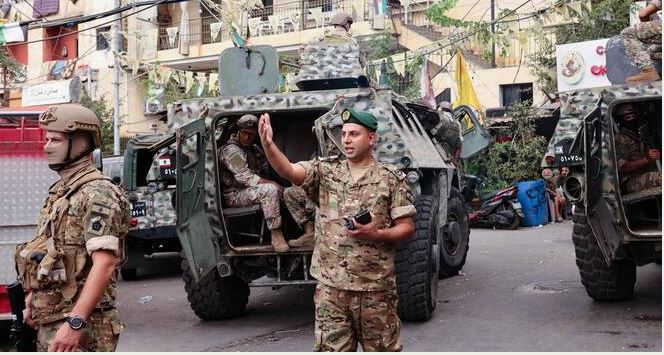
BEIRUT: The Lebanese army on Friday received a new batch of heavy weapons from Palestinian Liberation Organization factions in refugee camps in Lebanon.
These included the Shatila camp and Mar Elias camp in Beirut, as well as the Burj Al-Barajneh camp in Beirut’s southern suburb, in line with a Lebanese-Palestinian disarmament deal as part of the Cabinet’s decision to restrict weapons to the state.
While Lebanese army vehicles did not enter the Burj Al-Barajneh camp, the handover took place in the courtyard where the first batch was delivered last week.
Twenty-four hours earlier, the Lebanese army had received a batch of light and medium weapons, B7 rockets, and medium-range surface-to-surface missiles from the camps of Tyre, Rashidieh, Burj Al-Shemali and Al-Bass, all located south of the Litani River. The confiscated weapons were transported in eight trucks: six from Rashidieh, one from Al-Bass and another from Burj Al-Shemali.
The weapons handover did not include Hamas and Islamic Jihad weapons, as these two organizations are not subject to the authority of the PLO.
It included six of the 12 camps, the largest of which is Ain Al-Hilweh, the most densely populated, with the largest number of armed Palestinian factions.
The Cairo Agreement with the PLO at the end of the 1960s legalized the weapons of factions affiliated with the PLO in Lebanon. The agreement fell apart after the civil war in Lebanon, when President Amin Gemayel signed a law revoking it in 1987. The law abolishing the agreement was approved by the Lebanese Parliament.
The weapons of Palestinian organizations that were formed later, including those of Hamas and Islamic Jihad, were deemed illegal.
Ramez Dimashkieh, head of the Lebanese-Palestinian Dialogue Committee, told Arab News that negotiations over the weapons of Hamas, Islamic Jihad and other affiliated Palestinian forces are underway.
“We are talking about the weapons of the PLO factions, with whom we negotiated and reached an agreement. As for the weapons of Hamas, Islamic Jihad, and Palestinian forces orbiting around them, the matter requires negotiations with them,” said Dimashkieh.
He added: “A dialogue took place some time ago and it was positive, but after Hezbollah’s position declaring that it would not hand over its weapons, we do not know Hamas’ stance or that of the allied forces, and we must negotiate.”
The handover of weapons in Beirut has been completed, and the next stage will take place in the camps of northern Lebanon and the Bekaa, and later, north of the Litani River, said Dimashkieh.
In a statement in WAFA, Nabil Abu Rudeineh, the official spokesman for the Palestinian presidency, confirmed that the “relevant Palestinian authorities in Lebanon have handed over the third batch of weapons belonging to the PLO that were present in the Palestinian camps in Beirut, to be placed in the custody of the Lebanese army.”Agencies
US bars Abbas, others from UN as allies pledge statehood
The US has said it will not allow Palestinian Authority President Mahmoud Abbas to travel to New York next month for a United Nations gathering of world leaders, where several US allies are set to recognize Palestine as a state.
A State Department official said Abbas and about 80 other Palestinians would be affected by the decision to deny and revoke visas from members of the umbrella Palestine Liberation Organization and the West Bank-based Palestinian Authority.
Abbas had been planning to travel to New York for the annual high-level UN General Assembly at UN headquarters in Manhattan. He was also set to attend a summit there — hosted by France and Saudi Arabia — where Britain, France, Australia and Canada have pledged to formally recognize a Palestinian state.
Abbas’ office said it was astonished by the visa decision and argued that it violated the UN “headquarters agreement.”
Under a 1947 UN “headquarters agreement,” the US is generally required to allow access for foreign diplomats to the UN in New York. Washington, however, has said it can deny visas for security, extremism and foreign policy reasons.
The State Department justified its decision on Friday by reiterating longstanding US and Israeli allegations that the PA and PLO had failed to repudiate extremism while pushing for “unilateral recognition” of a Palestinian state.
Palestinian officials reject such allegations and say that decades of US-mediated talks have failed to end Israeli occupation and secure an independent state of Palestine.
“(It) is in our national security interests to hold the PLO and PA accountable for not complying with their commitments, and for undermining the prospects for peace,” the department said.
The State Department said that the Palestinian Authority’s mission to the UN, comprising officials who are permanently based there, would not be included in the restrictions.
French Foreign Minister Jean-Noel Barrot said Saturday there should be no restrictions on access to next month’s UN General Assembly, after the United States said it would deny visas to members of the Palestinian Authority.—Agencies